Cardio for Calisthenics: The Truth About Endurance & Strength
Think cardio kills your calisthenics gains? You're wrong. Here's how to build a bigger engine.

TABLE OF CONTENTS
1. The Engine of Your Performance
1.1. More Than Just "Getting Tired"
Many athletes—from calisthenics purists to handstand professionals—harbor a deep-seated belief that endurance training is the enemy of progress. They believe it cannibalizes strength gains and drains the very energy needed for skill work. This is a fundamental misunderstanding of what cardio truly is. It's not about punishing your legs; it's about building a superior engine. For a human, cardiovascular health is non-negotiable. For a calisthenics athlete, it is the secret weapon that unlocks elite levels of performance. We're not just training the heart and lungs; we are upgrading the entire system that supports your strength. Resistance training is excellent for your heart, but dedicated cardio is what forges true athletic stamina.
1.2. Train Harder, For Longer
Think about your last brutal set of Handstand Push Ups. What gave out first? Your shoulders, or your burning lungs? For many, the limiting factor isn't muscular strength, but the ability to continue performing at a high intensity. This is your Work Capacity. Endurance training supercharges this by forcing your body to adapt. It builds new capillaries, the microscopic highways that deliver oxygen-rich blood to your muscles. It makes your heart a more powerful pump and your lungs more efficient gas exchangers. The result? Your muscles get more fuel, faster. This allows you to push harder, squeeze out that extra rep, and hold that Planche for two more seconds. It's the difference between a good workout and a great one.
1.3. The Recovery Accelerator
Enhanced circulation is a two-way street. It doesn't just deliver supplies; it hauls away the metabolic byproducts that cause fatigue and soreness. This improved transport system means you recover faster, not just between workouts, but between sets. Imagine cutting your rest times while maintaining the same power output. You can accumulate more quality volume in the same amount of time, which is a direct application of Progressive Overload. Faster recovery between sessions means you can train more frequently, turning weeks into months of accelerated progress. It's not magic; it's superior physiology.
2. The Calisthenics-Specific Edge
2.1. The Lean Lever Advantage
In calisthenics, your body is the weight. Gravity is the only constant. While you can't change physics, you can manipulate your own body composition to gain a mechanical advantage. A lower body fat percentage directly improves your power-to-weight ratio. This isn't just about aesthetics; it's about making skills like the Front Lever or a Stalder Press objectively easier. While cardio alone won't sculpt a lean physique—that requires a dialed-in diet and consistent resistance training—it is an incredibly effective tool for increasing total energy expenditure and promoting fat loss. Staying lean gives you a definitive edge.
2.2. The Agility to Bail
If you are pushing the limits with skills like the One Arm Handstand or advanced ring work, you will fall. Bailing is not a sign of failure; it's a part of the process. The ability to fall safely and get back up is a skill in itself. Endurance work like running, swimming, or rope skipping doesn't just train your heart; it keeps your entire body agile, coordinated, and neurologically sharp. It enhances your Proprioception, allowing you to react instantly and catch yourself before a minor mistake becomes a major problem. This confidence to bail safely is what allows you to truly push your boundaries in training.
2.3. Fueling the Cellular Powerhouse
Beyond the heart and lungs, endurance training refines the very engines inside your cells: the mitochondria. These are the powerhouses that produce ATP, the energy currency of your body. Through consistent cardio, your mitochondria become more numerous and more efficient at using oxygen. This means your body can produce more energy aerobically, delaying the switch to anaerobic pathways that create lactic acid and cause that deep, burning muscle fatigue. You become more fatigue-resistant at a cellular level, allowing you to sustain high-effort contractions for longer.
3. Demolishing the "Cardio Kills Gains" Myth
3.1. The Truth About the Interference Effect
Here's the classic gym-bro argument: "Cardio kills gains." The truth is far more nuanced. Yes, an "interference effect" can occur where endurance training blunts strength and hypertrophy signals, but this is wildly misunderstood. Imagine you have a glass of water representing your total recovery capacity. If you pour all of it on one plant (strength), it might grow incredibly fast, but the others (endurance, mobility) will wither, eventually poisoning the soil for your primary plant. You have to water all of them. The principle of Specificity is key; to get stronger, you must prioritize strength. However, for 99% of athletes, the performance benefits of a strong cardiovascular base far outweigh any minimal interference. This issue only becomes a real concern for elite-level specialists training at maximum intensity in both disciplines simultaneously.
3.2. Protecting Your Muscle Mass
Your body needs fuel to recover from the demands of high-intensity running, rowing, or swimming. To protect your hard-earned muscle, you must be strategic with your nutrition. Running in a fasted state can encourage the body to tap into stored fat, but it can also increase the risk of muscle protein breakdown if not managed carefully. The solution is simple: ensure your diet is rich in high-quality protein, complex carbohydrates, and essential fats. Fuel your body for the work you are demanding of it. Cardio isn't the enemy of muscle; a poor diet is.
3.3. The Handstand Conundrum: Heavy & Stiff Legs?
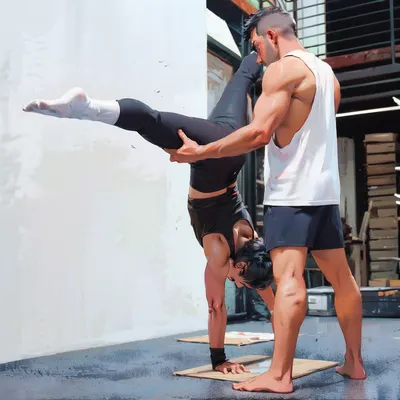
Handbalancers have specific fears. My old gymnastics coach feared that running would build heavy, stiff legs, making my handstands harder. He had a point, in theory. More mass requires more strength to hold up. But will it make your Handstand harder? Probably not. In fact, for most, it will make it easier. Training your legs teaches you how to engage them properly, creating tension through the entire Kinetic Chain from your hands to your toes. This turns your legs from dead weight into active stabilizers. The fear of stiffness is also misplaced. I used the heat from my cardio sessions as a perfect opportunity for deep Flexibility work. The result? I became more flexible, not less, unlocking a greater Usable Range of Motion and even resolving old lower back pain.
4. Forge Your Hybrid Engine: Your Strategic Blueprint
4.1. When to Train: Timing is Everything
So how do you weave cardio into your routine without compromising your strength work? In a perfect world, you'd have a 24-hour buffer between sessions. Realistically, a 6-hour break is more than enough to allow for recovery. If you must train them in the same session, always perform your priority training first. Do your strength and skill work while you're fresh, and finish with cardio. Studies show that combining them poorly can reduce strength gains by 18%, but combining them intelligently can actually elevate your results. Don't let your cardio session sabotage your main goal.
4.2. How Much and How Often
This depends entirely on your goals. For general health benefits, a brisk 30-40 minute walk each day is sufficient. To build athletic levels of endurance and stamina that will carry over to your calisthenics, you need to push harder. Aim for two dedicated cardio sessions per week. This is the sweet spot for driving adaptation without overwhelming your recovery resources. Listen to your body and adjust as needed. More is not always better.
4.3. HIIT vs. Steady State: Choosing Your Weapon
Both High-Intensity Interval Training (HIIT) and Low-Intensity Steady State (LISS) cardio are powerful tools, but they work differently.
- HIIT workouts are explosive and primarily target your type 2 (fast-twitch) muscle fibers. They are phenomenal for boosting your metabolic rate but will leave you more fatigued and sore, potentially impacting other training.
- Steady-state cardio, where you can still hold a conversation, primarily works type 1 (slow-twitch) muscle fibers and is less systemically taxing.
The best approach is a combination of both. Use steady-state cardio to build your aerobic base and HIIT sessions to push your top-end capacity. Stop seeing cardio as a separate, dreaded task. Start seeing it as the sharpening stone for your calisthenics blade. Forge your hybrid engine. Get to work.