Why I Became a Coach: My Journey From Circus to You
They said I was too old to start. I proved them wrong & became a Cirque Du Soleil handbalancer. Here's the truth about what it really takes.
TABLE OF CONTENTS
1. The Impossible Dream and the First Rejection
1.1. An Unlikely Beginning
It all started when I was 14. I was with friends, watching Olga perform in Varekai. The moment I saw it, something clicked. I turned to my friends and said, “Watch me. I am going to become the next Cirque Du Soleil hand balancer.” The room filled with laughter, but I was dead serious. This wasn't a fleeting wish; it was a declaration. However, the feedback from my older friends and family was swift and unanimous: it was an impossible idea. The consensus was clear—I hadn't started training at the age of five, so the window had closed. The world had already decided my fate before I even had a chance to try.
1.2. The Arrogance of Achievement
Fast forward. I graduated from circus school. I became a solo handbalancer for Cirque Du Soleil. Multiple times. After graduating, I was consumed by a certain kind of vanity. I genuinely believed I was special, that my journey was unique and my achievement singular. I thought I was the only one who could have defied those early predictions. This belief was a comfortable shield, but it was also a delusion. It was a story I told myself, and it was about to be shattered by the very people I started to teach.
2. The Shift from Performer to Teacher
2.1. The Great Realization
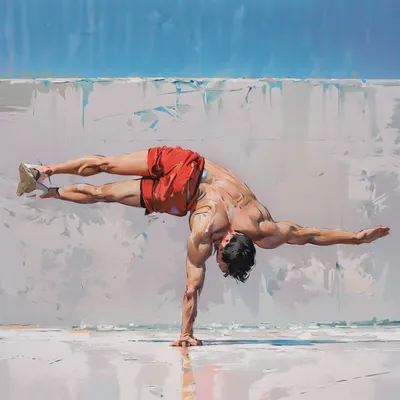
My perspective began to shift when I started teaching. A lot. I was giving up to 10 hours of private handstand lessons every single day before my shows. I was met with students who possessed an absolutely relentless dedication. I saw their struggles, their breakthroughs, and their unwavering commitment. And through them, one big realization settled in, fast and undeniable. You do not need to be special to learn a one arm handstand. You do not need to start at the age of 5 to become a master of Hand Balance. The only 'special' ingredient is the willingness to do the work, guided by the right principles.
2.2. Resisting the Call
Even with this powerful lesson learned, I fought the urge to embrace coaching more seriously. For the longest time, I resisted becoming an online coach. A selfish thought still lingered: my time was better invested in myself than in anybody else. I still had so much personal growing to do—as an athlete, as a husband, and in life. How could I justify investing my time in others if I hadn't yet become the person I aspired to be? It felt like a contradiction, a hypocrisy I wasn't ready to face. I was still focused on my own path, my own skills, my own evolution.
3. The Catalyst: A Mission Against Misinformation
3.1. The Social Media Problem
Ultimately, it was social media that pushed me over the edge. I watched so-called fitness influencers, people with half a million followers, promoting “beginner” handstand exercises that were not only setting people up for terrible Technique, but were also drastically increasing the risk of Injury Prevention. Their goal was simple: sales. Their strategy was even simpler: promise shortcuts and cheat codes to a handstand. They offered quick fixes for specific poses to get a nice-looking photo, all to extend their social media reach. It was a machine built on half-truths and dangerous advice, and it made me furious.
3.2. The Responsibility of Knowledge
Seeing this flood of misinformation, I felt a sense of responsibility. I knew what it took. I had gone through the process. I had failed at gymnastics, literally becoming the disgrace of my club because I couldn't hold a handstand. I knew intimately that there are no cheat codes. There is only hard work paired with the right exercises, the right cues, and a deep understanding of alignment and Biomechanics. This is the only path that ensures not only constant growth but also health and longevity in your practice.
4. The Philosophy: No Shortcuts, Only Smart Work
4.1. The Myth of a 'Hard' Skill
Handstands aren't easy. High-level Hand Balance is complex. It takes a huge amount of time to develop and pretty much just as much time to maintain. If done wrong, with poor Technique and a focus on shortcuts, it is incredibly rough on the body. It can cause a load of unnecessary injuries, chronic soreness, and frustration. But here's the truth they don't tell you: when done correctly, hand balancing is actually soft and friendly on the body. It's about finessing your Center of Mass over your hands, not fighting against gravity.
4.2. Proving the Method
I've lived this philosophy. I performed for 10 years at the highest technical level, doing up to 15 shows a week, and I haven't missed a single show or training session due to injury. Not once. This isn't because I'm indestructible; it's because I trained smart. I focused on a foundation of proper Technique and perfect alignment through principles like Joint Stacking. There's no reason you should get injured, either. With the right approach, you can build incredible Straight Arm Strength and Scapular Stability without wrecking your wrists and shoulders. The key isn't brute force; it's intelligence and precision.
5. My Promise: Redefine What's Possible
5.1. You Are Not Too Late
What you truly need is dedication and, most importantly, a strong understanding of Hand Balance Technique. Everybody can learn a handstand. Everybody can learn a one arm handstand. And I am here to help with that. My mission is to show all those 15, 25, or 35-year-old dreamers out there that it is not too late. You did not miss your shot. A one arm handstand is beautiful and impressive, but it is not unachievable. Today, I know I'm not that special. I am, however, aware that I will outwork anybody else in the room. I might not be the fastest learner, the strongest, or the most flexible, but I am stubborn enough to never, ever give up. And neither should you.
5.2. Let's Build Together
This is my promise to you. Together, we can challenge the old narratives and the self-imposed limitations. We can learn, we can grow, and we can redefine what is possible for the human body. Let’s train together. Let’s grow together. Let’s redefine what the human body is truly capable of.
Get to work.