Middle Split Swimmer: The Ultimate Guide to Unlock Your Hips
Stop stretching and start building. Unlock your middle split with the one drill that forges both strength and flexibility.

TABLE OF CONTENTS
1. The Swimmer: Your Blueprint for an Elite Middle Split
1.1. What is the Middle Split Swimmer?
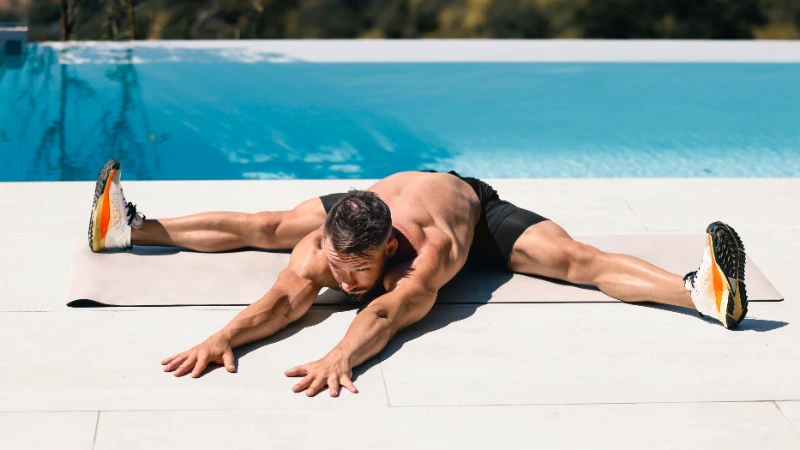
The Middle Split is a benchmark of grace and power. It grants Mechanical Advantage in advanced calisthenics, adds aesthetic lines to acrobatics, and builds unshakable stability in skills like the One Arm Handstand. But nothing worth having comes easy. A true Middle Split is forged over years, demanding a brutal combination of Flexibility, specific strength, and razor-sharp Proprioception. The biggest barrier? The beginning. It’s a disorienting mess of where to engage, what to stretch, and how to even start. This is where the Middle Split Swimmer becomes your most powerful tool. It’s a legendary Flexibility drill from gymnastics designed to build coordination, strength, and range of motion simultaneously. Imagine this: you start seated, legs together, posture tall. You dynamically open your legs into your widest straddle and fold forward into a Pancake. From there, you slide everything—hands, torso, hips—forward until you arrive in a Middle Split, hips kissing the floor. Then, you close the legs to finish on your stomach. The reverse is even more demanding: actively pulling the legs open, sliding past the split into the Pancake, and using pure strength—not your hands—to return to the start.
1.2. Why the Swimmer is Non-Negotiable
This movement isn't just a stretch; it's a lesson in force and control. It demands immense Active Flexibility and hip strength. The dynamic nature allows you to work in and out of the tightest corners of your Pancake and Middle Split, teaching your body how to navigate these positions with power. It’s not just for the elite; it's a mandatory tool for every level.
- Beginners: You're nowhere near a Pancake. The Swimmer forces you to find the Anterior Pelvic Tilt—the foundational hip movement that isolates your Hamstrings and Adductors instead of just rounding your spine. The constant opening and closing of the legs builds the coordination to ease into deeper ranges over time.
- Intermediates: You can get into a decent Pancake. The Swimmer will burn the difference between the Pancake and the Middle Split into your nervous system. This knowledge is key to executing cues correctly and applying pressure where it matters. You'll learn to actively work against the stretch, forging true strength in your end range.
- Advanced: You have your Pancake. You have your Middle Split. Now, you execute the Swimmer with grace. You will be forced to use your hip muscles to actively rotate the legs, to use your core and back strength to control the descent, and to master the highly technical reverse movement. This is where you transform a position into a seamless Movement Pattern.
2. The Three Pillars of a Perfect Swimmer
2.1. Pillar 1: The Controlled Pancake Descent
This is where it begins. As you lower into the Pancake, you must aggressively engage your back, pulling hard into an Anterior Pelvic Tilt to slow the movement. If you relax, you collapse. It's that simple. Crucially, do not internally rotate your legs here. While that makes it easier to slow down, it robs you of the specific training stimulus we are chasing. Keep the legs in External Rotation to isolate the correct muscles.
2.2. Pillar 2: The Hip Lift and Roll
Now for the transition. The goal is to get your hips up and align your tailbone with your spine. This is not easy. It requires ruthless dedication. Place your elbows as close to your hips as possible and drive your hips into a strong Posterior Pelvic Tilt. In one fluid, semi-dynamic movement, you will push your knees into the floor, use your forearms as a pivot, and roll your hips up and forward. The wider your Pancake, the easier this becomes. Eventually, you'll be able to slide forward effortlessly, without the push from the forearms.
2.3. Pillar 3: The Armless Ascent
This is the part most people fail. I used to blame my heavy upper body—a lame excuse. The goal is to return to an upright position without pushing off the floor. The secret? Internally rotate your legs and drive your big toes into the ground. Use this applied pressure to arch your back and pull your hands up, leading the movement. Keep your arms locked and close to your ears. Spreading them wide creates a shorter lever and makes it easier, which means you're cheating yourself.
3. The Path to Mastery: Swimmer Progressions
3.1. Step 1: Mobilize and Coordinate
Before you can swim, you must learn to float. Your first job is to develop basic hip Mobility and coordination. Use this time to master the difference between an Anterior Pelvic Tilt and a Posterior Pelvic Tilt. This is not optional. It is the language your hips speak. Focus on keeping your knees locked throughout every drill.
3.2. Step 2: Forge Your Pancake
Now, we build the foundation. Work into a deeper Pancake stretch, but maintain a straight or slightly arched back. We are targeting your Hamstrings and building Usable Range of Motion, not just rounding your spine. Begin incorporating reps where you open your legs far past your normal straddle width. Keep the legs externally rotated. Don't use the big toe trick to get up yet; focus on building the raw strength to pull yourself up.
3.3. Step 3: Prep for the Transition
Things are getting serious. The goal here is to get your forearms to the floor in your deepest Pancake. This is a non-negotiable checkpoint. Remember the cue: bring your elbows in, close to your hips. If they are too far forward, you will not have the leverage to perform the hip lift in the next stage. Use yoga blocks under your hips to adjust the difficulty. There is no shame in scaling; there is only shame in poor execution.
3.4. Step 4: The Swimmer to Elbows
Finally. It is time to add the Middle Split itself. At this stage, everything must work in perfect harmony. You should only attempt this progression when you are truly ready. Your [c]Pancake[/e] is strong, your hip control is precise, and your will is absolute. Use these progressions as tools. Be smart. Be responsible. Choosing a progression that is too hard is a recipe for injury and zero results. High quality movement is the only path to healthy, consistent gains.
4. Programming the Swimmer for Maximum Gains
4.1. Training Frequency and Intensity
Integrate Middle Split Swimmer progressions into every middle split session. If you are just starting, aim for a combined hamstring, Pancake, and Middle Split session 2-3 times per week. Always warm up thoroughly. Break a sweat. A warm body is a pliable body. While active drills are critical, you must respect your body's need for Recovery. These drills will induce soreness; that's the sign of adaptation. Give your body time to rebuild.
4.2. Listening to Your Body
Over time, you can increase your session frequency to 5 or even 6 times per week. But understand this: your body is in a constant state of flux. What works this week might not work next week. What feels good in the summer might feel impossible in the winter. This isn't a failure; it's feedback. Listen to your body. Adjust your weekly volume accordingly. Training is a dialogue, not a monologue.
5. Forge Your Middle Split: The Final Call
The Middle Split Swimmer is not just an exercise; it is the ultimate tool for deconstructing and rebuilding your middle split, no matter your level. It teaches strength, control, and resilience. It transforms a passive stretch into an active, powerful skill. The path is long, and it demands dedication. But every rep, every controlled descent, every fight to come back up, is a step towards mastery. Warm up well.
Get to work.