Pancake vs. Middle Split: The Ultimate Flexibility Guide
Think the Pancake and Middle Split are the same? Think again. This distinction is the key to unlocking elite flexibility and power.

TABLE OF CONTENTS
1. Deconstructing the Pancake Stretch
Many athletes work on their Pancake Stretch without even realizing it, often as a casual part of a warm-up or cool-down. But to mistake this for a simple, passive exercise is the first error on the path to elite Flexibility. The Pancake Stretch isn't just about getting low; it's a technical skill that demands precision and focus. It’s the true foundation for advanced Compression strength and a non-negotiable prerequisite for skills like the Press to Handstand and Stalder.
1.1. The Anatomy of a Perfect Pancake
Precision is everything. To execute a true Pancake Stretch, you must sit on your ischial tuberosity—your “sit bones”—with your knees pointing directly towards the ceiling. The primary action is not folding over, but hinging at the hips. The mission is to bring your belly button, not your nose, towards the floor. This requires a strong Anterior Pelvic Tilt, an active forward rotation of the hips that keeps your lower back straight and protected. Rounding your back is a critical failure; it negates the stretch and shifts dangerous load onto your lumbar spine. While artistic gymnastics traditionally dictates a 90-degree angle between the legs, for our purposes, you can adjust this angle to target different muscle fibers or prepare for specific skills.
1.2. Target Muscles and Common Pitfalls
The Pancake Stretch is a masterclass in targeting the posterior chain, with a laser focus on the Hamstrings. By opening the legs, you stretch these muscles at a unique angle that a standard Pike Stretch can't replicate. Flexing your feet intensifies this, bringing your calves into the equation. The biggest mistake we see is a lack of intention. It's easy to mindlessly hang out in this position, but a lazy stretch is an ineffective and potentially dangerous one. If you lose the Anterior Pelvic Tilt or allow your knees to bend, you’re not just wasting time; you're cheating the movement and risking injury. This is a battle of millimeters, won with unwavering focus and a deep Mind-Muscle Connection.
1.3. Progressions and Variations
Like any skill, the Pancake Stretch can be scaled. If you're struggling to maintain a flat back, elevate your glutes on yoga blocks. This small change reduces the demand on your Hamstrings and allows you to focus on the correct pelvic position. To increase the intensity, elevate your feet. This creates a deficit, allowing you to fold deeper than the floor would normally permit. Two powerful variations to accelerate your progress include:
- The Weighted Standing Pancake: Stand on two benches or boxes with a weight in your hands. Allow the weight to pull you down, focusing on a deep, passive stretch. At the end of the hold, simply drop the weight. We are chasing Flexibility, not conditioning.
- The Banded Pull: Secure a resistance band to a pole in front of you. Use your arms to pull your torso forward, assisting the Anterior Pelvic Tilt and deepening the stretch.
2. Mastering the Middle Split
A good Pancake Stretch is common. A true Middle Split is a rare display of specialized Mobility. While it may appear less technical than the pancake, it demands a specific line of Flexibility that is far more challenging for most athletes to develop. It's the key to unlocking a wider straddle for skills like the Straddle Planche and Front Lever, providing a significant Mechanical Advantage.
2.1. The Biomechanics of the Middle Split
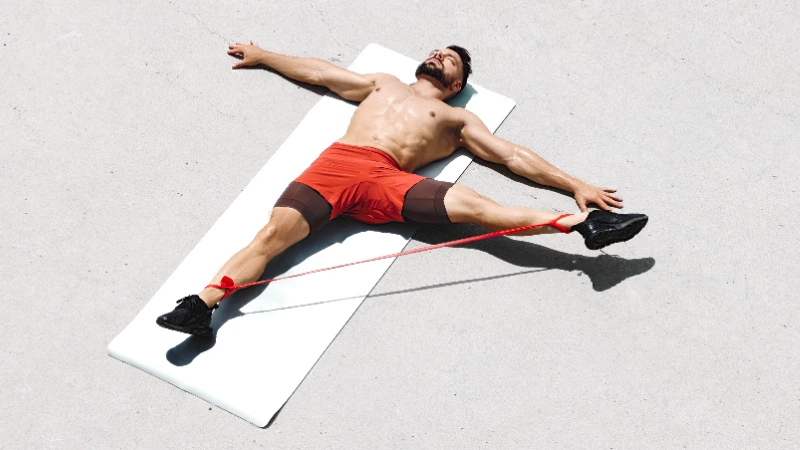
The fundamental difference lies in pelvic orientation. For a proper Middle Split, your pelvis must rotate 90 degrees forward. You are essentially lying on your stomach with your legs abducted to the sides. Your sit bones should point directly behind you, and your knees must point forward, in the opposite direction. This position requires significant External Rotation at the hips. Critically, your knees must remain fully locked out, with your quadriceps actively engaged to protect the joint. This is non-negotiable for both safety and effectiveness.
2.2. Target Muscles and Common Failures
The primary target of the Middle Split is the adductor muscle group—the inner thighs. Depending on your level, you'll also feel a significant stretch in the Hamstrings and even the calves. The most common failure is a mismatch between ambition and ability. Athletes often attempt a full Middle Split before they're ready, leading to poor form, such as bent knees or a failure to rotate the pelvis. If the exercise is too difficult, you cannot maintain correct alignment, and the stretch will not deliver results. It could even lead to serious knee injury. Respect the progression.
2.3. Progressions and Key Variations
Progressing the Middle Split is straightforward in principle. Place pillows or yoga blocks under your pelvis to find a height where you can relax into the stretch with manageable discomfort. Over weeks and months, gradually remove the support until you are flat on the floor. To go beyond, you can then elevate your feet. Of course, it's rarely that simple. Here are two vital variations:
- Frog Pose: If you cannot fully straighten your knees in a Middle Split, focus on the Frog Pose. With both knees bent and on the floor, you can work on the pelvic tilt and adductor Flexibility without placing stress on the knee ligaments.
- Wall Middle Split: Lie on your back with your glutes, Hamstrings, and calves pressed firmly against a wall. Allow gravity to open your legs. You can add ankle weights or use a band to gently increase the stretch. This is an excellent way to accumulate Time Under Tension safely.
3. The Critical Connection: How They Work Together
Now that we've broken them down, it's clear: the Pancake Stretch and Middle Split are entirely different beasts. They look similar but demand fundamentally different actions from the pelvis and target different muscle groups. An athlete with a great Middle Split often has a good Pancake Stretch, but the reverse is not necessarily true. A great pancake does not guarantee a great middle split. Yet, their relationship is deeply synergistic.
3.1. The Pancake as Middle Split Prep
The Pancake Stretch is a critical stepping stone on your journey to the Middle Split. While the middle split is an adductor-dominant stretch, your Hamstrings are still placed under significant tension. The forward fold of the pancake, combined with open legs, creates a unique hamstring stretch that is the perfect preparation for the demands of the middle split. It teaches the crucial skill of controlling the Anterior Pelvic Tilt, building the Coordination and body awareness necessary for more advanced Flexibility work.
3.2. The Swimmer: Bridging the Gap
There is no better exercise to highlight the intimate connection between these two positions than the Middle Split Swimmer. This advanced drill is a fluid transition from a deep Pancake Stretch into a full Middle Split and back. It requires you to internally rotate your legs in the pancake, use your arms to pull your body forward, and then control the pelvic rotation to align your hips and feet for the middle split. The Middle Split Swimmer is the ultimate expression of Active Flexibility, demonstrating not just range of motion, but the strength and Coordination to move through it. It proves that while they are not the same, they are inextricably linked.
4. Forge Your Flexibility: The Path Forward
So, are the Pancake Stretch and the Middle Split the same? Absolutely not. Are they two sides of the same coin? Unquestionably. The pancake forges your Hamstrings and teaches the all-important pelvic tilt. The middle split attacks your Adductors and unlocks the straddle necessary for elite calisthenics skills. Neglecting one will inevitably create a bottleneck that limits the other.
Mastering both is not just about doing cool stretches. It's about building a more resilient, capable body. It's about unlocking the Mechanical Advantage needed for the Press to Handstand, the Stalder, and the Straddle Planche. This is your blueprint. Understand the mechanics, respect the progressions, and commit to the work. True Mobility is earned, not given.
Get to work.