The Ultimate Guide to Flexibility for Calisthenics
Stop wasting time with useless stretches. Unlock the real principles of flexibility to boost your skills.

Welcome to Handstands and the rest THE Podcast where I discuss Handstands, Bodyweight Fitness, Calisthenics and Flexibility training.
TABLE OF CONTENTS
1. The Real Reason You're Not Getting Flexible
1.1. Beyond Tying Your Shoes: Quality of Life & Performance
Let's cut through the noise. Flexibility, Mobility, range of motion—call it what you want. Everyone has an opinion, and everyone promises a secret. But the truth is simpler and far more powerful. For over 15 years, my career has depended on achieving and maintaining elite-level Flexibility while performing at the highest athletic levels. What I've learned from coaches, therapists, and relentless self-experimentation is this: genuine Mobility isn't just about party tricks. It's about fundamental human function.
Improving your usable range of motion directly impacts your posture, leaving you feeling better day-to-day. It’s the difference between tying your shoes without a twinge in your back and reaching overhead without feeling a restrictive pull in your shoulders. It is, quite simply, a direct upgrade to your quality of life. In a world of desk jobs and sedentary lifestyles, what was once a natural human state has become a medical necessity for many, making targeted Flexibility training non-negotiable.
1.2. The Double-Edged Sword of Flexibility
However, a word of warning. Flexibility is not a magic bullet. Simply stretching will not fix all your problems or keep you young. Chasing extreme flexibility without building the requisite Strength and end-range control can leave you in a worse place than where you started—unstable, and vulnerable. This is the critical difference between passive range and Usable Range of Motion. The goal is not just to lengthen tissues, but to own every millimeter of that new range with strength and absolute control. Remember, our muscles are not simple rubber bands; they are viscoelastic. While a rubber band snaps back immediately, a muscle can hold a lengthened position, creating a temporary window of increased range. This is useful, but without the strength to control it, it's a liability.
1.3. The Mechanical Advantage You're Missing
Now for the reason most of us are really here: performance. Increased Flexibility is not about vanity; it's about physics. It grants you a powerful Mechanical Advantage that makes difficult skills easier and more accessible. A well-developed middle split doesn't just make your Straddle Handstand look cleaner; it provides a more stable base and allows you to manipulate your Center of Mass more effectively, directly benefiting your Planche and Front Lever.
Likewise, superior hamstring Flexibility is a game-changer for skills that require deep Compression. Movements like the Skin the Cat, Press to Handstand, and L-Sit become significantly less demanding, allowing you to break through plateaus and advance to more difficult skills faster. You're not just getting more flexible; you're making yourself a more efficient and capable athlete.
2. The Code of Flexibility: What Truly Matters
2.1. The Principle of Specificity: Target Your Weakness
Anyone who has seriously pursued Flexibility knows it can be an uncomfortable process. This discomfort should motivate you to be ruthlessly efficient. Your body adapts specifically to the demands you place upon it—this is the law of Specificity. Stretching your Hamstrings will not improve your Bridge or your shoulder Mobility. While a balanced routine is essential, your primary focus must be goal-specific.
Every joint is its own unit. Hips and shoulders are ball-and-socket joints, designed for a vast range of motion. An elbow, by contrast, is a hinge. You must respect this anatomy. Furthermore, different types of Flexibility require different training. Passive Flexibility drills will only have a partial carryover to Active Flexibility. To master a skill, you must train the precise qualities it demands.
2.2. Your Personal Blueprint: Genetics, Age, and Gender
The beauty of humanity is our uniqueness, but in training, this means we all progress at different rates. The natural elasticity of your muscle tissue, tendons, and ligaments is highly individual and will influence your ultimate Flexibility potential. Gender and age are also significant factors. Female athletes often tend to be more pliable than their male counterparts, and younger bodies adapt more readily.
You can expect to see a natural decline in Flexibility beginning around age 55, with a more pronounced drop-off in the mid-60s, primarily affecting the shoulders and hips. This isn't a death sentence; it's a call to action. It simply means your training must become smarter and more consistent to counteract the effects of time. Your blueprint is your starting point, not your destiny.
2.3. The Human Factor: Your Focus Determines Your Reality
Genetics play a role, but they are not the final word. Ultimately, your progress comes down to one question: how badly do you want it? Are you scrolling through your phone while you stretch, or are you present and focused? Do you show up, day in and day out, with intention and discipline? The ability to learn a Movement Pattern and execute it with precision is a skill in itself. Small adjustments in Coordination and body awareness can dramatically alter the effectiveness of a stretch.
Your pain tolerance is also a significant indicator. While we never push into sharp pain, your ability to sit with and breathe through intense discomfort determines how deep you can go. Finally, your overall health and Recovery status will dictate how hard you can train. All of these factors are within your control. They are the variables that separate those who wish for Flexibility from those who earn it.
3. The Science of the Stretch: How You Actually Get Flexible
3.1. Rewiring Your Hardware: Physical Body Adaptations
So how does this transformation actually happen? It’s not magic; it’s adaptation. The human body is a master of adjusting to external stress. Your fascia and muscles respond to repetitive stimuli by becoming more pliable. Scientific studies have found that sarcomeres—the smallest contracting units of your muscles—are added or subtracted based on use. Consistent Flexibility training signals the body to recruit additional sarcomeres into the Kinetic Chain, which structurally lengthens the muscle over time. You aren't just temporarily elongating the tissue; you are fundamentally changing its architecture.
3.2. Hacking Your Software: Brain and Nervous System Adaptations
The other half of the equation is your brain. Your gains are governed as much by your nervous system as by your muscle tissue. Through repetitive, controlled stretching, your muscles learn to trust your brain's commands under tension. This isn't a figure of speech; it's a real process of Neural Adaptation. Your brain's threat perception is lowered, and your stretch reflex becomes less sensitive, allowing the muscle to relax more deeply into a stretched position. This is why progress takes time. You are building a high-stakes relationship between your mind and your muscles—a relationship built on trust and consistency.
4. The Arsenal: Your Stretching Toolkit
4.1. Dynamic Stretching: Priming the Engine
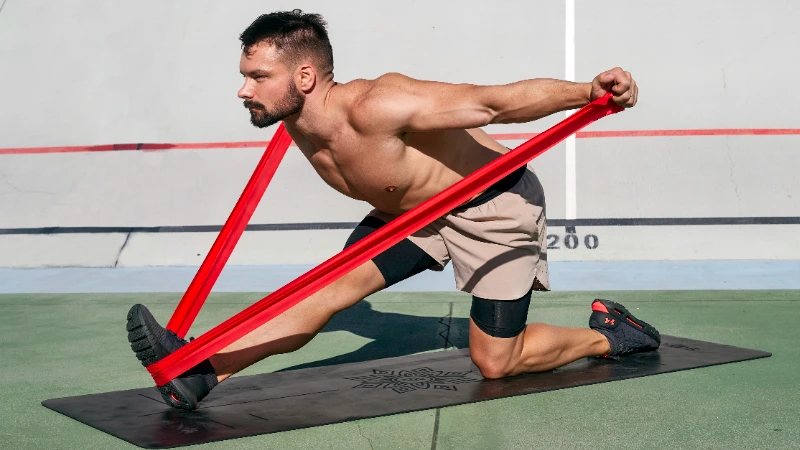
Dynamic stretches are your first line of attack. This is where you use controlled momentum to gently guide a joint in and out of a range of motion. These movements don't push to your absolute limit but serve to increase blood flow, raise tissue temperature, and improve your Proprioception. They are non-negotiable in any effective warm-up and are particularly useful for beginners to start exploring their current ranges safely.
4.2. Static Stretching: The Bedrock of Gains
Static stretches are the most common and foundational form of Flexibility training. Here, you hold a position at your end range for a prolonged period, using an external force like gravity, your bodyweight, or a prop to maintain the stretch. This is where you put in the time under tension necessary to signal to your body that it needs to adapt. This method is slow, controlled, and allows you to focus intently on your alignment and breathing, making it the bedrock of any serious flexibility program.
4.3. PNF Stretching: Hacking Your Reflexes
PNF Stretching, or Proprioceptive Neuromuscular Facilitation, is a more advanced technique. It is a powerful tool, especially for long Kinetic Chains like the Hamstrings. The method involves an engage-relax cycle: you first isometrically contract the stretched muscle against an immovable force for a few seconds, which pre-fatigues it and inhibits the protective stretch reflex. Then, upon relaxing, you can often sink significantly deeper into the stretch. It's a direct hack on your nervous system that can yield impressive results.
4.4. Ballistic & Active Stretching: Advanced Weaponry
Ballistic stretches use momentum, often from an opposite muscle group, in an attempt to push the target muscle beyond its current end range. Due to the high degree of force and low level of control, these are for advanced athletes only and should be used with extreme caution. Active stretches, on the other hand, focus on using the strength of one muscle group to stretch the opposing one. For example, using your quadriceps and hip flexors to lift your leg high in a standing split. While some studies suggest this helps the target muscle relax, I believe Active Flexibility work is best programmed as part of your conditioning, building the crucial Strength at end range that defines Usable Range of Motion.
5. The Battle Plan: Your Strategy for Lasting Gains
5.1. The Law of Consistency: Show Up or Give Up
We now understand the what and the why. It's time for the how. Lasting Flexibility gains are slow. This is a feature, not a bug. You are fundamentally altering your body's structure and nervous system; this should not happen overnight. Fast, aggressive gains almost always lead to injury. Current research suggests that to manifest lasting change, it takes about 10 minutes of daily stretching for at least two months. In my experience, you will feel the progress much sooner, but understand that it will come in waves. Weeks of feeling stuck can be followed by a sudden breakthrough. Your job is to remain consistent through it all.
5.2. The Art of Pressure: How Far is Too Far?
One of the most critical questions is how hard to push. The answer is highly individual, but the rule is simple: go less hard than you think. Forget the "no pain, no gain" mantra. We are aiming for mild to moderate discomfort, never sharp pain. You should be able to breathe deeply and carry on a conversation while in a stretch. Your perception of this discomfort will change over time; what feels intense to a beginner may feel mild to an advanced athlete. Crucially, you must reassess your range of motion in every single workout. Your end range is not a fixed point; it changes daily. Respect that, and train the body you have today, not the one you had yesterday.
5.3. Timing is Everything: Duration and Frequency
How long and how often? The science varies, but a general consensus points to holding static stretches for 30-60 seconds per set. If you're just starting, you can build up to this, beginning with shorter holds. For frequency, I recommend targeting each major muscle group three times per week. This could be three dedicated sessions, or you could spread the work across more days. Beginners may see results stretching every other day, but an advanced athlete dedicated to a specific goal like a full Middle Split or Pancake will likely need to train daily.
5.4. Optimizing Your Environment: Prime Yourself for Success
To maximize efficiency, you must control every variable. Time of day matters. Most people are stiffest in the morning and peak in flexibility between 2-4 PM. Body temperature is critical. Research shows that joints and muscles are more pliable when your core temperature is elevated by 1-2 degrees Celsius. A proper warm-up is non-negotiable. Nutrition and hydration also play a massive role. Proper hydration keeps muscles supple, while adequate calcium and potassium can reduce cramping. Finally, your training space should be warm to help you maintain body heat during passive holds. If it's a cold space, wear layers. Every detail matters when you're demanding profound change from your body.
6. Your Mandate for Mobility
We've dismantled the myths and laid out the blueprint. True, lasting Flexibility is not born from mindless, painful stretching. It is forged through a precise, intelligent, and consistent application of stress and Recovery. It's a synthesis of physical adaptation and neurological trust, built one deliberate session at a time.
Understand the principles. Respect your body's individual nature. Choose the right tools for the job, and execute with unwavering focus and consistency. This is not a passive pursuit; it is an active campaign to reclaim your body's potential and unlock a new level of performance. The path is clear.
Get to work.