How to Master the L-Sit: The Ultimate Calisthenics Guide
The L-Sit is a brutal, honest test of true strength. It's more than a core exercise. Here's how to conquer it.

TABLE OF CONTENTS
1. Deconstructing the L-Sit: The Blueprint for Success
1.1. What is the L-Sit and Why Does It Matter
The L-Sit is a foundational Calisthenics skill where you support your entire bodyweight on your hands, with legs held straight out, parallel to the floor. It looks deceptively simple, but don't be fooled. This position is a brutal, honest test of your Strength, Mobility, and Discipline. It's a highly scalable goal for anyone starting their journey and an non-negotiable checkpoint for athletes aiming for elite skills like the Press to Handstand or Planche. In gymnastics, it's the gateway position, the ready stance from which incredible feats of power are launched. Mastering the L-Sit isn't just about learning a cool party trick; it's about forging the fundamental Bodyweight Strength and Control that underpins your entire practice. A perfect L-Sit shows locked elbows, pointed feet, a long neck, and an unwavering, straight-backed posture. It can be performed on the floor, on rings, or on parallettes, each offering a unique challenge.
1.2. The Four Pillars of a Rock-Solid L-Sit
The L-Sit isn't complex, but its list of physical demands is long enough to command respect and inspire real, lasting changes in your body. Every link in your Kinetic Chain must do its job. If one fails, the entire structure collapses. Let's break down the four non-negotiable pillars.
- Pillar 1: Upper Body Strength. This is the most obvious requirement. Your arms must support your entire body. This demands serious triceps strength to maintain locked elbows and powerful shoulders to execute Shoulder Depression—the act of keeping your shoulders packed down and stable, away from your ears. Any exercise that builds Straight Arm Strength and Bent Arm Strength will contribute here. Think Triceps Dips, Overhead Triceps Extensions, and all forms of straight-arm balance work like Handstand holds.
- Pillar 2: Core Strength and Compression. Forget six-pack abs from endless crunches. The L-Sit requires deep, functional Core Stability. Your core connects your powerful shoulders to the rest of your body, stabilizing your hips and legs under immense load. More importantly, it demands active Compression—the ability to powerfully squeeze the angle between your torso and legs. This isn't passive; it's an aggressive, active engagement. This is where gymnastics-style stability exercises like Hollow Body Holds and rocking boat abs become invaluable.
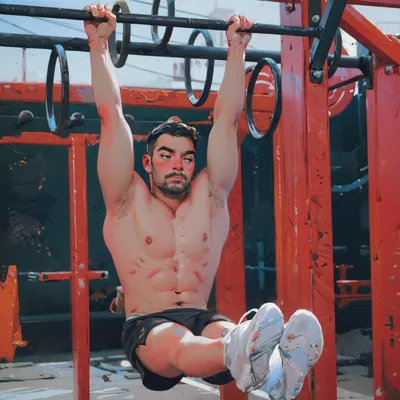
- Pillar 3: Leg & Hip Flexor Strength. This is the forgotten link. Your legs aren't just hanging there; they are actively held in position. This requires full engagement from your quads and calves to keep the legs straight and stable. If you're not used to this level of Full Body Tension, you will cramp. Furthermore, your hip flexors are on fire, working overtime to hold your legs parallel to the floor, creating that critical 90-degree angle at the hips. Forget traditional leg days. To build specific strength, focus on drills like hanging Leg Lifts and seated leg lifts.
- Pillar 4: Hamstrings Mobility. You don't need to be a contortionist, but you must understand this fundamental law of Biomechanics: to lift your legs, you fight gravity and the resistance of your own tissues. Getting stronger makes fighting gravity easier. Getting more mobile makes fighting your body's internal resistance easier. If your Hamstrings are tight, you're essentially trying to lift your legs with the emergency brake on. Your hip flexors have to work exponentially harder. Improving your Usable Range of Motion here provides a massive Mechanical Advantage.
2. Forging the Foundation: Building Overwhelming Strength & Mobility
2.1. The Hamstring Mobility Test
Before you even attempt an L-Sit, you must assess your hamstring Flexibility. Here's a simple, brutally honest test: Sit on the floor with your back pressed firmly against a wall. Ensure your glutes are touching the wall and your back is completely straight. Now, lock your knees and try to slide your heels away from you. Do you feel a significant stretch in your Hamstrings? If the answer is yes, you have work to do. That tension is what you'll be fighting against. If you feel no discomfort, hamstring Mobility isn't your primary bottleneck, but you should still work on it to prepare for future skills like the V-Sit and Pike Press to Handstand.
2.2. Essential Strength-Building Exercises
Targeted exercises are the key to building the specific Strength required. This isn't about random workouts; it's about precision. Incorporate these into your routine:
- For Triceps & Shoulders: Master Triceps Dips on a bench or parallettes, focusing on a full Range of Motion. Scapula Push Ups are non-negotiable for teaching the brain the pattern of Scapular Protraction and depression. Upper supports on p-bars or rings, simply holding your body up with locked arms, build incredible Scapular Stability.
- For Core & Compression: Your two best friends are hanging Leg Lifts and seated leg lifts. For hanging lifts, focus on controlling the negative and minimizing swing. For seated lifts, lean back slightly to start, and focus on lifting with your core, not just your hip flexors. [e]Hollow Body Holds[/c] are also foundational for teaching total-body tension.
2.3. The Right Gear for the Job
Here's a vital, often overlooked tip: choose your training attire wisely. If you’re trying to squeeze in a session at the office, change out of your jeans and take off your shoes. You know how heavy an overweight suitcase is at the airport; the same principle applies here. Clothes and shoes add weight and restrict movement. You are challenging yourself to learn a new, difficult skill. Don't make it harder than it needs to be. Set yourself up for success. Take off the shoes.
3. The Path to Mastery: Your Progression Roadmap
3.1. Progression 1: Elevate Your Hands
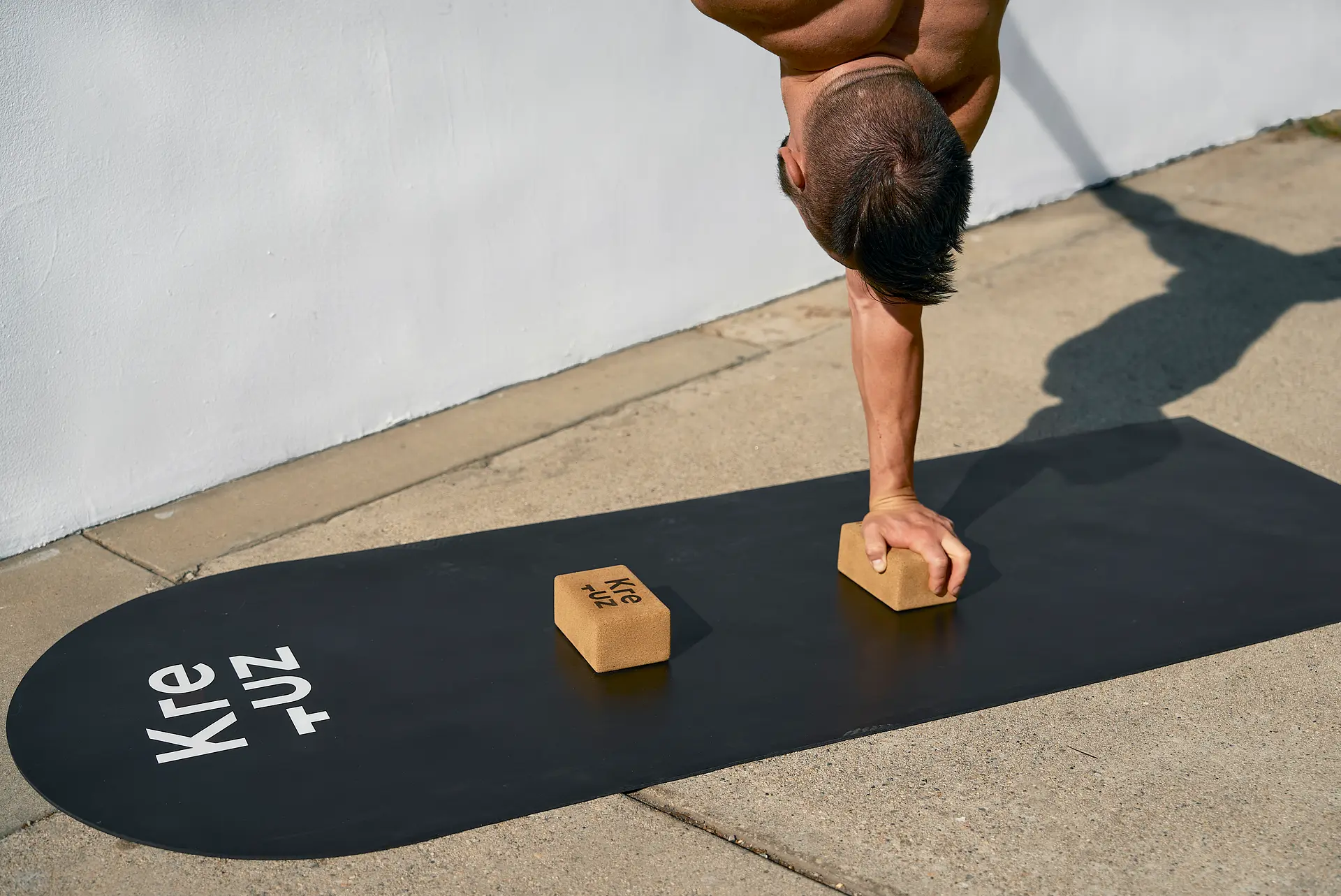
What makes the L-Sit so difficult is lifting the legs against gravity. The logical first step, then, is to give your legs more room, making the lift easier. The higher you elevate your hands, the easier the L-Sit becomes. Start with your hands on high parallettes, chairs, or stacks of books. This increased height reduces the demand on both Compression strength and hamstring Mobility, allowing you to focus on the upper body mechanics of Shoulder Depression and maintaining locked arms. As you get stronger, gradually decrease the elevation—moving to lower parallettes or yoga blocks—before finally graduating to the floor. The floor is the final boss.
3.2. Progression 2: Partial & Single-Leg L-Sits
This progression builds strength and endurance directly in the target position. Start in a support position with your hands on the floor or elevated, but keep your feet on the floor with legs straight. This is a partial L-Sit. From here, you can simply hold for time, focusing on depressing your shoulders and locking your elbows. To increase the intensity, perform push-ups from this position, coming to a dead stop at the bottom of each rep. The most powerful variation here is the single leg lift. From the partial L-Sit, lift one leg until it is parallel to the floor, hold for a moment, and lower it with Control. Alternate legs. This drill is a fantastic way to build unilateral strength and prepare for the full two-legged hold.
3.3. Progression 3: Isolate and Conquer
An incredibly effective way to approach any complex gymnastic skill is to isolate each component, work on it separately, and then assemble the pieces for the final result. This is the principle of Specificity in action. For the L-Sit, this means dedicated isolation work:
- Hip Flexor & Compression Drills: Seated and hanging leg lifts, Tuck Ups.
- Elbow Extension Drills: Triceps Bench Dips, all Push Up variations.
- Scapular Stability Drills: Upper supports on parallettes, Scapular Push Ups, and hangs from a pull-up bar focusing on Shoulder Depression.
By strengthening each link in the chain independently, the final combined movement becomes exponentially more achievable.
4. Beyond the Hold: Integration and Application
4.1. How to Program L-Sit Training
The L-Sit is primarily a strength skill. Therefore, it demands Recovery. Never train it every day. Your muscles need time to repair and adapt; a 48-hour rest period between dedicated L-Sit sessions is a solid rule of thumb. How you integrate it depends on your current Workout Split.
- Weightlifting/Bodybuilding: Add your L-Sit work on upper body push days. Crucially, train it after your general warm-up but before your heavy lifts. You need your full physical and mental capacity, which will be gone after a heavy bench press session.
- Yoga: A yoga class is the perfect environment. You are warmed up, your muscles are activated, and you have access to blocks to scale the progressions. Train it during or immediately after your class.
- Dance: Most dance classes are high-intensity. Train your L-Sit before class, otherwise your body will likely be too fatigued and shaky to safely work on arm balances.
- Home Workouts: You can combine the advice above. Train L-Sits on your push-heavy days. Always perform them after your warm-up but before your most demanding exercises. Ensure you aren't doing heavy pushing or Handstand work the day before to allow for proper Recovery.
4.2. What Comes Next: The Path Forward
For most athletes, achieving the L-Sit is not the destination; it's a signpost. It proves you've built a foundation, and now, the real work can begin. The path forward is long and rewarding.
Immediate next-level progressions include the L-Sit Dip, the Tuck V-Sit, and small Tuck Planche lifts from the L-Sit. These skills challenge your Strength and Control in a more dynamic fashion.
Long-term goals that build directly from the L-Sit are some of the most iconic skills in Calisthenics: the Pike Press to Handstand, the Stalder on rings, and eventually, the L-Sit to Planche.
4.3. Your Journey Is Your Own
The L-Sit is arguably the ultimate entry-level skill. It's scalable and achievable for almost everyone, yet it offers a lifetime of refinement and progression. Allow yourself the time you need. Take it one step at a time and burn this into your mind: we are all on our own journey, with our own starting points and our own destinations. Your progress is yours alone. Work hard, stay healthy, and stay hungry.
Get to work.