The Ultimate Guide to Calisthenics Workout Programming
Stop chasing skills and start building strength. Your blueprint for a calisthenics workout that delivers real, lasting results.
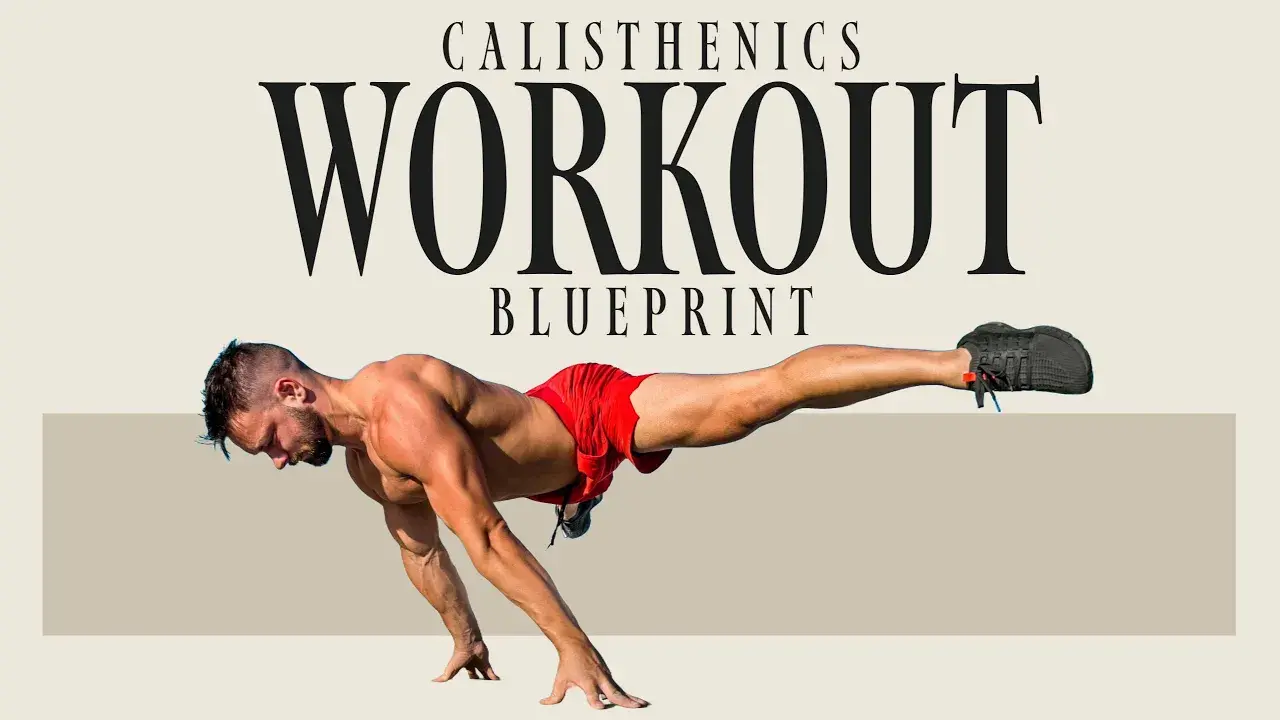
Learn the necessary step to take in order to write the best workouts possible.
TABLE OF CONTENTS
1. The Blueprint for Real Strength
1.1. Why a Plan is Your Only Path to Progress
Many of us get into calisthenics to chase cool skills, build an impressive physique, and feel powerful in our own bodies. But here's the hard truth: most workout plans are built around chasing skills, not around science-backed, health-centric structures. This gymnastics-style, goal-oriented training can deliver quick, flashy results, but it often leads to a dead end. Your body develops one-sidedly, creating imbalances that pave the road to plateaus and injury. The real goal should never be just to master a single Movement Pattern; it's to elevate how your entire body functions as a single, powerful unit. If you want to get good at anything, you need a plan. Without one, you're just guessing, and guessing is the enemy of progress. A well-structured plan is the only way to guarantee you're not just working hard, but working smart.
1.2. Monitor, Adjust, and Dominate
A written plan isn't a prison; it's a diagnostic tool. By tracking what you did last week, you know exactly what you need to do this week to apply Progressive Overload. It’s the only way to know for sure if you're getting stronger. Consistency is king, and a plan enforces it. If every workout is a random collection of exercises based on how you feel, you're guaranteed to create an imbalanced routine. You'll gravitate towards the exercises you enjoy and are good at, while neglecting the ones you probably need the most. Having an established routine is the only way to make intelligent adjustments. Feeling fatigued? Recovering from a minor tweak? Have extra energy to burn? A plan allows you to make smart, targeted changes without derailing your long-term progress. It allows you to identify your personal limiting factors and attack them with precision.
1.3. How a Plan Forges Mental Fortitude
Life is busy. You're not a professional athlete with unlimited time and energy. You'll be tired, distracted, and there will be days you don't feel like training. This is where a plan becomes your greatest ally. It eliminates decision fatigue. You don't have to think; you just have to execute. You have a clear list of what needs to be done. So you get in, and you get it done. This focus is non-negotiable on days when you're mentally scattered. Investing the time to write a multi-week plan is infinitely more effective than scrambling to figure out what to do every single time you train. It builds discipline, and discipline builds results.
2. Laying the Foundation for Your Ultimate Workout
2.1. Defining Your Mission
Before you touch a bar or kick up into a Handstand, you need to get honest with yourself. What are you truly hoping to accomplish? Sit down and analyze what genuinely excites you, while also considering what a smart next step is for your overall physical development. This isn't just about picking a cool skill; it's about charting a course.
2.2. Health Is Non-Negotiable
This should be obvious, but it’s the rule most often broken. Your first and most important goal must always be to remain healthy and train sustainably. It doesn't matter what skill you're chasing. If you get injured, your training stops. Your happiness plummets. Injury Prevention isn't a separate activity; it is the intelligent foundation of every workout you build. Take care of your mental and physical health above all else, so you can continue to do what you love.
2.3. Choosing Your Skill Goals
How many skills can you chase at once? This is a question I get constantly. The good news is that many calisthenics skills have a high degree of carryover. For example, the strength built for a Handstand Push Up directly supports your Planche training. This allows you to put certain skills on a 'maintenance' dose without losing progress. As a general rule, I recommend focusing on one primary push skill and one primary pull skill at a time. For this guide, we'll choose the Handstand Push Up and the Front Lever. Remember, you'll still be training your entire body in all anatomical directions; these are just the skills that will receive the most focused attention.
2.4. Your Most Valuable Asset: Time and Recovery
Finally, be realistic about your resources. How much time can you dedicate to each workout, and how many sessions can you realistically complete per week? This isn't just about hours in the gym. You must also account for life stress, sleep quality, and nutrition, as these factors dictate your ability to recover. Recovery is where you get stronger. A perfectly designed plan is useless if you can't recover from it. Three to four well-executed sessions per week are far superior to six sloppy, under-recovered ones.
3. The Science of Building a Superior Body
3.1. How Much Volume for Real Growth?
Modern exercise science provides a clear road map for muscle growth. To trigger Hypertrophy, you need to perform hard working sets—any set taken close to muscular failure. The exact rep range is less critical for muscle size, but for strength, higher intensity sets in the 3-6 rep range are ideal. It’s crucial to understand that failure on a complex skill like the Handstand Push Up is different from a dumbbell press. Technique failure, balance failure, and muscular failure are all distinct. Here’s the blueprint for weekly volume per muscle group:
- Maintenance: ~3 hard sets per week.
- Growth: 7-10 hard sets per week.
- Maximized Growth: 10-12 hard sets per week.
Anything beyond 12 high-quality sets is likely junk volume—it adds fatigue with little to no extra benefit. Don't just train hard; train smart.
3.2. Choosing Your Training Split
Now we know the required volume. Trying to cram 12 sets for every muscle group into a single workout is a recipe for disaster. Your performance would plummet after the first few exercises, and the sessions would be brutally long. This is where training splits come in. By combining our weekly volume targets with our available training days, we can choose an intelligent split. The most effective splits for calisthenics are:
- Full Body: Excellent for beginners and those training 2-3 times a week. Ensures high frequency for skill practice.
- Upper/Lower: A fantastic split for intermediate athletes, allowing more volume per session for the upper and lower body.
- Push/Pull/Legs (PPL): A classic split, great for advanced athletes who need to manage high volumes and want to focus on specific movement patterns each day.
For our example, we'll use an Upper/Lower split and focus on designing a killer Upper Body day.
4. Assembling Your Workout: From Template to Weapon
4.1. Creating the Foundational Template
The first step is to create a balanced template that trains the entire upper body across its primary Movement Patterns. We aren't focused on skills yet; we're focused on building a complete, structurally sound athlete. This ensures no muscle is left behind.
An upper body day must include:
- Vertical Pushing: Targets the shoulders and triceps (e.g., Pike Push Up)
- Vertical Pulling: Targets the lats and biceps (e.g., Pull Up)
- Horizontal Pushing: Targets the chest, shoulders, and triceps (e.g., Push Up, Dip)
- Horizontal Pulling: Targets the upper back and biceps (e.g., Bodyweight Row)
4.2. Integrating Your Goal-Specific Exercises
Now, we replace the general movements in our template with exercises that directly target our chosen goals: the Handstand Push Up and the Front Lever. We also need to adjust the order. The most neurologically demanding skills must come first, when you are fresh and can generate maximum force. With our goals in mind, the exercises that help us advance in those skills get top priority. If you have multiple exercises for one skill, the hardest one goes first.
Our new workout order is:
1. Handstand Push Up (or its progression) - Vertical Push
2. Front Lever Row (or its progression) - Horizontal Pull
3. Dip (Weighted if necessary) - Horizontal Push
4. Weighted Chin Up - Vertical Pull
This structure ensures we attack our goals with maximal energy while maintaining a balanced push-to-pull ratio.
4.3. The Warm-Up: Priming the Machine
This is where a general strength session transforms into a high-performance calisthenics workout. It's non-negotiable. First, a general warm-up to raise your heart rate and break a light sweat. Then, a specific warm-up focused on activation and Injury Prevention. For our example, this means rotator cuff and wrist work for the Handstand Push Ups. It also means specific lat activation drills to improve the Mind-Muscle Connection for the Front Lever, like Scapula Pull Ups or Skin the Cats. Your technical Handstand balance work also happens here, before your nervous system is fatigued from the main working sets.
4.4. Technical Sets vs. Working Sets
This is a crucial distinction. Technical sets are physically easy. They are performed with assistance or at a much easier progression to allow you to focus purely on perfect form and Technique. For the Handstand Push Up, this could be wall-supported shoulder leans. For the Front Lever, it might be band-assisted Scapular Retraction holds. Working sets are the hard sets we discussed earlier—the ones taken close to failure that actually build strength and muscle. For our workout, you might perform 4 hard sets of Handstand Push Ups and 4 hard sets of Front Lever Rows. It's tempting to do more, but trust the science. Quality over quantity.
4.5. Finishers and Isolation Work: Forging Elite Strength
Calisthenics skills are complex. It's often difficult to reach true muscular failure due to balance or technical limitations. This is where isolation work and finishers become powerful tools. Goal-specific isolation addresses weak links. For the Handstand Push Up, this could be Scapular Protraction and Scapular Elevation[/e] work. For the Front Lever, it could be more retraction drills. If you're working on a Tuck Planche or Press to Handstand, this is where you'd add your [c]Compression work. Finishers are a brutal, effective way to ensure you've hit your volume targets. A Handstand Push Up finisher could be a drop set, moving down progressions from HSPU to Pike Push Up to a weighted shoulder press with no rest. The possibilities are endless, but the goal is the same: exhaust the target muscles completely.
5. Bulletproofing Your Body for Longevity
5.1. Counter-Balancing and Prehab
Now that the main workout is built, we audit it for potential imbalances. We add exercises to counter the stress of our goal-specific work. Since our example is heavy on pushing, we need to ensure our horizontal pulling is robust. We already have Front Lever Rows, but adding an exercise like Face Pulls or high rows for the rear delts and external rotators is critical for shoulder health. If you were training for the One Arm Chin Up, you would add forearm work like ball squeezes to prevent elbow issues. This isn't optional; this is how you stay in the game.
5.2. Building a Pillar of Core Stability
Every workout should end with dedicated core work. A strong core is not just for aesthetics; it's the transmission for force between your lower and upper body. It provides the Core Stability that keeps your body in a rigid line during skills like the Handstand and Front Lever. Train exercises like the Plank, Bird Dog, and Hollow Body Hold to build a core that works on autopilot, freeing up your mental energy to focus on the complex mechanics of advanced skills.
5.3. The Unilateral Advantage
I've made it a rule to include at least one unilateral exercise in every routine. We all have a dominant side, and bilateral exercises (using both limbs at once) allow that stronger side to compensate for the weaker one. Unilateral work—training one side at a time—exposes and eradicates these imbalances. Exercises like the Single Arm Push Up, Archer Row, or Pistol Squat force the weaker side to do its job. They also present a massive challenge to your core's Anti-Rotation ability, building truly functional strength. This is a powerful tool for smashing through plateaus.
6. Evolve or Stagnate
6.1. Rotating Exercises to Avoid Plateaus
A well-built template is your foundation, but it's not set in stone. To avoid accommodation and keep making progress, you should rotate certain exercises. Keep your primary goal-specific lifts constant, but cycle your secondary and accessory movements. For example, you could swap Dips for Planche Push Ups for a few weeks, or alternate between wide Bodyweight Rows and Face Pulls from one workout to the next. This introduces new stimuli, shores up weaknesses, and keeps your training engaging.
6.2. Your Path Forward
Building a workout is a skill in itself. The possibilities are endless, but the principles are simple. Research and establish a well-rounded plan, but don't fall into the trap of analysis paralysis. The most important step is to start. Get in the gym, test your new routine, and pay attention to how your body responds. At the end of the day, training is far simpler than we make it out to be. Train your entire body, maintain high intensity, stay focused, and recover well. Now you have the blueprint.
Get to work.