Fix Your Arched Back HSPU: The Ultimate Form Guide
That arched back in your HSPU is killing your gains and risking injury. Here's how to fix it for good.

TABLE OF CONTENTS
1. The Anatomy of a Flawed Handstand Push Up
1.1. Identifying the Arched Back
One of the most persistent and damaging mistakes in the Handstand Push Up (HSPU) is allowing the back to arch during the push. This isn't a minor detail; it's a fundamental breakdown of form that can appear at any stage of your progression. An arched back during the ascent doesn't just look sloppy—it dramatically increases injury risk and shifts the focus away from the targeted muscles. This Form Collapse often stems from two sources: a genuine lack of Overhead Pushing Strength or, more insidiously, a deeply ingrained bad habit forged by repeatedly training with progressions that are simply too difficult. You're cheating the movement, and your body will pay the price.
1.2. Why Your Body Chooses the Path of Least Resistance
The extreme arch in the lower back is not random; it's a desperate attempt by your body to find a Mechanical Advantage. By arching, you fundamentally alter the shoulder angle, allowing your chest muscles to contribute far more effectively. It's the same biomechanical cheat we see in a heavy Bench Press, where athletes arch to shorten the range of motion and engage the powerful pectorals. Your body instinctively wants to use the chest—it's a powerhouse. When you arch, the shoulders are forced to close, creating the necessary angle to recruit the chest for the push. This tells us one critical thing: the shoulder angle is necessary, but arching is the wrong way to achieve it. The correct method involves a strategic shift of your center of gravity, not a compromise of your spinal integrity.
2. Engineering the Correct Movement Pattern
2.1. The Counterweight Principle
To fix the arch, we must replicate the advantageous shoulder angle without compromising the spine. The solution lies in understanding counterweights. In the bottom position of your Handstand Push Up, you must consciously move your head further forward, towards your fingertips. At the same time, you'll bring your feet slightly towards your stomach. This forward head position acts as a crucial counterweight, allowing you to maintain balance as your hips shift. This maneuver creates the ideal shoulder angle to engage the chest powerfully and correctly. You are giving your body what it wants—chest engagement—but on your terms, with perfect form. You must actively hold this angled body line throughout the entire push. It requires more control and a stronger Mind-Muscle Connection, but it's the only path to a legitimate HSPU.
2.2. Re-wiring a Faulty Motor Pattern
If you've been training with an arched back, you haven't wasted your time, but you have built a faulty Motor Pattern. You've developed some specific strength and coordination, but now it's time for a tactical retreat to build a stronger foundation. This is non-negotiable. You must take a couple of steps back. Select an easier progression or reduce your reps. Focus on building strength and, just as importantly, awareness. You need to feel what a straight-back HSPU is like. This isn't a punishment; it's a strategic regression to unlock future progress. Your ego has no place here. Only disciplined, focused work will rebuild the movement from the ground up.
3. Advanced Strategies for Forging Raw Strength
3.1. Drop Sets for Muscular Failure
If you can manage a few reps with perfect form before your back begins to arch, Drop Sets are your best weapon. This technique is a brutal but effective application of Progressive Overload.
- Perform as many reps as possible with flawless form at your current progression.
- The moment your form is about to break, immediately drop to an easier progression.
- Pump out several more reps to push the target muscles to absolute failure.
This method works across all variations. Training the L Handstand Push Up? Drop from feet on the box to knees on the box. Working on wall-assisted reps? Drop to Pike Push Ups. This strategic push beyond initial failure is what builds the raw strength needed to maintain form under duress.
3.2. Overcoming Progression Gaps with Weighted Training
Sometimes, the gap between two progressions feels like a chasm. This is where external weight becomes a powerful ally. Find a progression you can comfortably perform for 8 clean reps, like a deep Pike Push Up or an easier wall variation. Add a weighted vest that reduces your max reps to just 4-6. Your mission is to work your way back up to 8 reps with that added weight. This systematic increase in resistance builds a surplus of power. When you return to the harder bodyweight progression, you'll feel shockingly light and strong, effectively bridging the gap you once thought was impassable. This is about being creative and refusing to accept plateaus as a final destination.
4. The Unbreakable HSPU: Your Final Correction
4.1. The Faith and Fingertips Fix
If you are certain you possess the required strength, yet the arch persists, the issue is likely habit, a lack of technique, or a crisis of faith at the bottom of the rep. The moment you reverse direction from down to up is the absolute hardest point of the HSPU. It's common to feel for a split second that the push is impossible. Do not panic. Resist the urge to cheat. Hold the position, trust your strength, and have faith that the movement will reverse. Wait for the leverage to shift in your favor as you push. Simultaneously, ensure you have adequate weight on your fingertips. If your weight drifts to the heel of your palm, your center of gravity is off, and a powerful push is impossible. Maintain forward pressure and use your Fingertip Control to stabilize the entire system.
4.2. The Block Method: Forcing Honesty
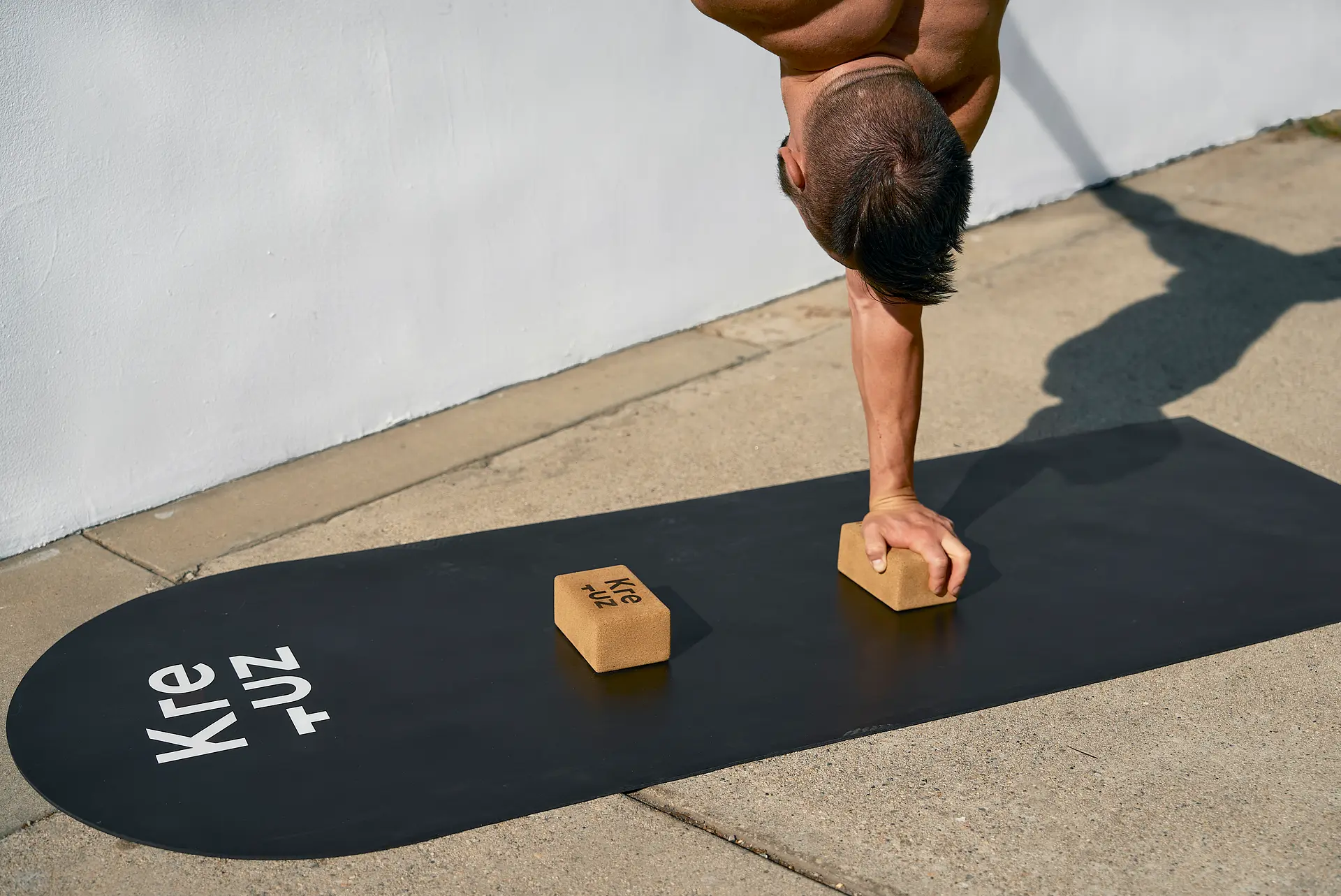
Here is the ultimate secret weapon for killing the arch for good: the yoga block. Place a block or a similar object on the floor in front of your hands, just where your head would travel. This simple tool acts as a physical barrier, forcing you to push upward first, before you can move your head backward. The most common error is to pull the head back toward the hands prematurely, which is what initiates the arch. The block makes this impossible. It demands an honest, vertical initial push. This trick is brutally effective for any HSPU progression and works wonders to build the correct Movement Pattern. Arching your back is not a sign of weakness to be ashamed of, but failing to take action is a choice. Leave your ego at the door, work with intelligent progressions, and build the strength, control, and awareness for a powerful, injury-free Handstand Push Up.
Get to work.