Handstand Push Up Plateau? Here’s Your Guide to Break Through
Stuck on your Handstand Push Up? It's not just about strength. Here's how to diagnose your weakness and break through any plateau for good. #HSPU #Calisthenics

TABLE OF CONTENTS
1. Decoding the HSPU Stalemate
1.1. Why You’re Really Stuck
The Handstand Push Up (HSPU) is a beautiful monster. It’s a unique fusion of raw strength, impeccable technique, and unwavering Hand Balance. This complexity is what makes it so rewarding, but it’s also a minefield for plateaus. Progress isn’t a straight line; it’s a jagged path of constant adaptation. If you feel like you’re grinding your wheels, it’s not because you aren’t working hard enough. It’s because one of the core components—strength, balance, or technique—is lagging. The first problem is that you’re forced to develop three separate qualities simultaneously to advance one skill. The second, and more critical problem, is that you have to correctly diagnose which of the three is your current bottleneck. Unfortunately, the real culprit is often masked, making it incredibly difficult to target the right solution.
1.2. The Strength Deficit
This is the most obvious culprit. You need to be able to overhead press your entire bodyweight, and if the raw power isn't there, you'll feel it. The classic sign of a strength deficit is getting stuck at the bottom of the movement or collapsing without control. Another, more subtle sign is being able to push back up, but only by arching your back into a "banana" shape. This is your body cheating the Movement Pattern, shifting the load from your shoulders to your stronger chest muscles. It’s a clear indicator that your dedicated overhead pressing power needs work. Without the requisite strength, no amount of balance or technical refinement will get you through the rep.
1.3. The Balance Breakdown
All the strength in the world is useless if you simply fall over. While many HSPU progressions like the Pike Push Up strategically remove the balance component, it becomes a non-negotiable factor for the freestanding Handstand Push Up or the Bent Arm Press to Handstand. If you find yourself tipping over the moment the press gets difficult, your Proprioception and Fingertip Control are the weak links. This isn't just about holding a static handstand; it's about maintaining your center of mass over your hands while your body is in dynamic, powerful motion. A lack of balance forces you to rush, preventing you from applying your strength at the most mechanically efficient moment.
1.4. The Technique Gap
Technique is the blueprint for movement. Without a deep understanding of correct positioning, your strength and balance have no foundation to build upon. If you don't know where your body should be in space, you’ll adopt positions that are impossible to balance or mechanically inefficient for producing force. A common technical flaw is a lack of Scapular Elevation—failing to push tall through the shoulders—which creates instability from the very start. Another is improper timing. If you initiate the push at the wrong moment, with your weight in the wrong spot, you misdirect your force and hit a wall. Mastering technique requires conscious study and deliberate practice.
2. Engineering Your Breakout
2.1. Isolate and Conquer the Weak Link
Plateaus are not walls; they are signals. They’re telling you exactly what to work on. Your primary mission is to isolate the missing piece and attack it with precision.
- If it's strength: Stop banging your head against full reps. Regress to an easier HSPU progression where you can complete at least 6 clean reps. Think Pike Push Ups with elevated feet or wall-assisted reps. Additionally, dedicate time to accessory work. Isolate your anterior deltoids and triceps with conditioning exercises like dumbbell presses or Tricep Dips. Build the raw materials.
- If it's balance: Dedicate a separate part of your training to pure Hand Balance. Work on wall-supported drills like Wall Handstand Slide Aways and tuck-ups. Crucially, perform your balance work before your heavy HSPU conditioning, when your nervous system is fresh and receptive.
- If it's technique: Become a student of the craft. Watching others train, analyzing videos, and reading articles like this one are all part of the process. Record yourself. Compare your form to elite examples. Understand that there's always something to learn, no matter how advanced someone seems.
2.2. Add More Steps to the Ladder
This is the most logical, yet most overlooked, strategy for avoiding plateaus. Imagine trying to get stronger at the gym with only 45-pound plates. Every jump in weight would be a monumental leap. But if you have 5-pound and 2.5-pound plates, you can make small, consistent progress every single week. This is the essence of Progressive Overload, and it applies just as much to calisthenics as it does to weightlifting. The goal isn't to make huge, infrequent leaps from a Pike Push Up to an Chest to Wall HSPU. The goal is to create as many micro-progressions as possible, allowing you to take a small step forward every single session. Your progress will be relentless because the next step is always within reach.
3. The HSPU Scaling Matrix
3.1. Making the Impossible, Possible (Easier Variations)
When the next progression feels a million miles away, the answer is to bring it closer. By making the currently unreachable skill slightly easier, you place it within your grasp. This is intelligent training.
- Slow Negatives: The eccentric (lowering) phase of a movement is where you are strongest. Exploit this. Lower down from the top of the next progression as slowly as humanly possible. If you feel a "sticking point" where you start to lose control, freeze and resist. Don't just lower; fight gravity every inch of the way. This builds incredible strength and control in the exact range of motion you're failing in.
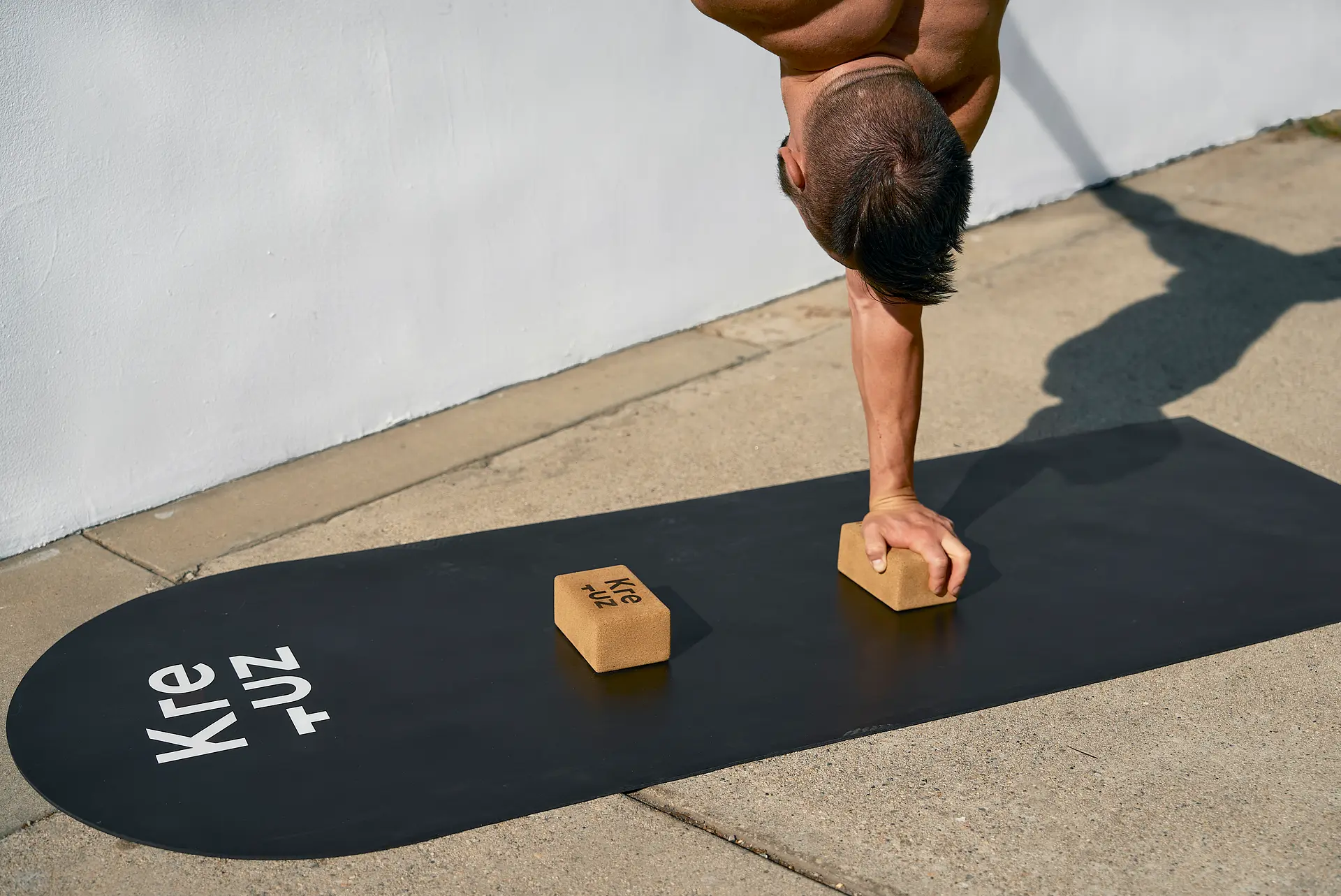
- Partial Reps: Shorten the range of motion to decrease the required force. Place two yoga blocks or a stack of books between your hands. Lower down until your head gently taps the blocks, then press back up. This not only makes the movement achievable but also provides a clear, measurable path for progress. As you get stronger, simply remove a block to increase the range.
- Assisted Reps: An elastic band hung from above can be a game-changer. It provides the most help at the bottom of the movement—exactly where most people fail—and less help at the top. This requires some experimentation with setup and band tension, but it perfectly mimics the strength curve of the HSPU and allows you to train the full Movement Pattern with proper form.
3.2. Making the Possible, Harder (Advanced Variations)
The inverse approach is just as powerful: take the progression you've already mastered and make it more challenging to bridge the gap to the next level. Whenever you increase the difficulty, your focus on perfect form must be absolute to maximize gains and minimize injury risk.
- Elevate Your Feet: This is a simple but brutally effective method, especially for the Pike Push Up. Elevating your feet shifts more of your body weight into your hands and shoulders, directly increasing the load and the strength stimulus.
- Increase Range of Motion (ROM): Elevate your hands on parallettes or yoga blocks. This allows you to lower your head past your hands, dramatically increasing the ROM and the Time Under Tension. An athlete who can perform deep L-Sit HSPUs likely has the raw strength for partial freestanding reps.
- Dead Press: This is a personal favorite for forging raw, honest strength. In each rep, bring your head to rest gently on the floor. Pause for a full second, completely relaxing the pushing muscles. Then, press back up from a dead stop. This eliminates the stretch-shortening cycle (muscle elasticity), forcing your muscles to generate 100% of the force from zero.
- Add Weight: The most straightforward tool in the toolbox. A weighted vest increases the demand on every progression. If you can master your current level with an extra 10kg, the next progression without weight will feel significantly easier.
3.3. Combining Concepts for Ultimate Progress
This is where you graduate from following a plan to becoming your own coach. True mastery lies in understanding these scaling principles and combining them to create the perfect progression for your specific needs. The possibilities are endless, limited only by your creativity.
Here are a few powerful combinations:
- Dead Partials at the Next Level: Struggling with the full freestanding HSPU? Place a block on the floor, lower to it, pause in a headstand, and then press up. You're combining the reduced ROM of a partial rep with the brutal starting strength of a dead press.
- Deep Assisted Reps: Set up for a deep L-Sit HSPU with your hands on blocks. At the bottom of the rep, touch your knees to the box your feet are on. This momentary assistance allows you to push back up, training the full range of motion while deloading the weakest point.
- Weighted Negatives: This is for the advanced athlete seeking maximum stimulus. Wear a weight vest while performing slow negatives on your goal progression. This is one of the most potent ways to build strength and overload the system.
4. Become Unstoppable
The path to the Handstand Push Up is a marathon, not a sprint. The frustration of a plateau is real, but it is never a dead end. It is simply a puzzle waiting to be solved. The two most critical takeaways are to isolate your specific weakness—be it strength, balance, or technique—and to use micro-progressions to create small, winnable steps. Stop thinking in giant leaps and start thinking in inches.
There is no reason to ever be truly stuck. By understanding and creatively combining these methods of scaling, you can design an endless road of progress that leads directly to your goal. The power to break through is in your hands.
Get to work.