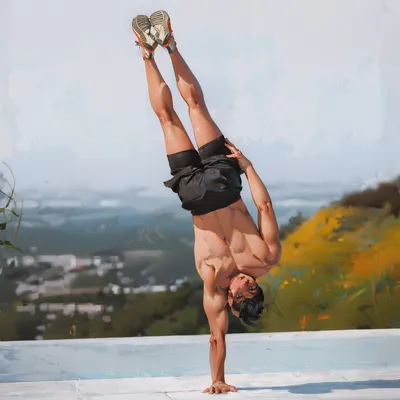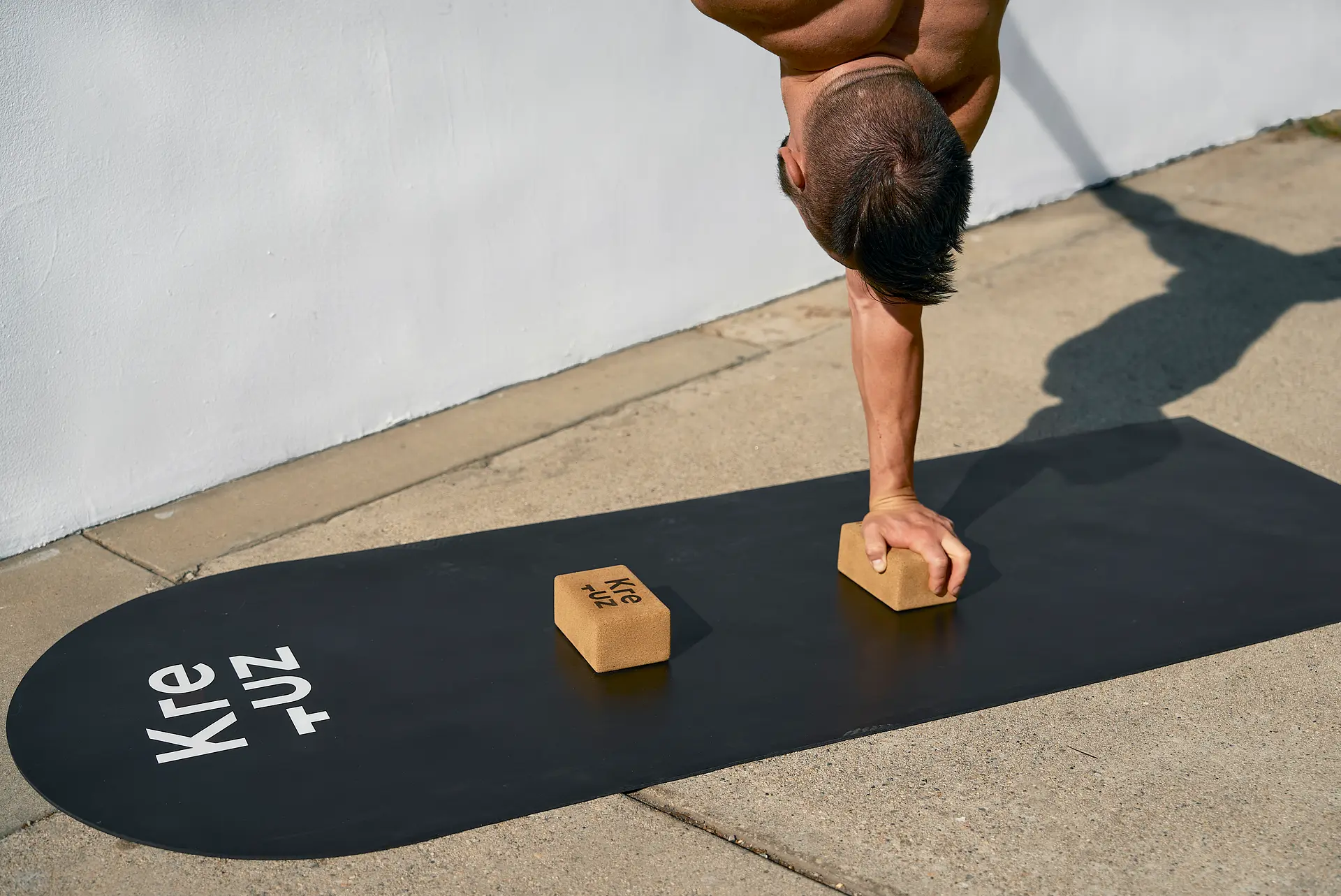
Fix Your Straddle Handstand: The Ultimate Guide to Perfect Form
Is your straddle handstand holding you back? Stop piking your hips and arching your back. Learn the secret to perfect alignment.
TABLE OF CONTENTS
1. Defining the Correct Straddle Handstand
1.1. The Anatomy of a Perfect Line
The Handstand is a game of millimeters. When every joint is stacked and every muscle fires in unison, it feels effortless. But a single weak link in the Kinetic Chain, and the entire structure crumbles. While most athletes obsess over their shoulders, a major source of these Energy Leaks is hiding in plain sight: your hips and legs in the Straddle Handstand.
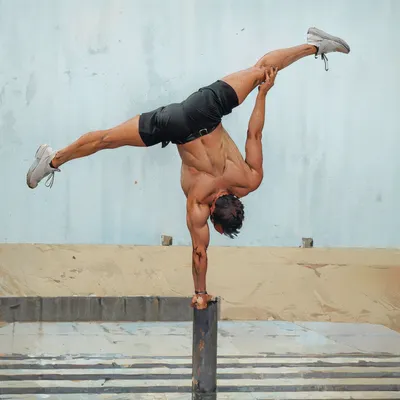
Many roads might lead to Rome, but you're here because you want the most efficient path. The same principle applies to your Hand Balance practice. There is a correct, mechanically superior way to perform the Straddle Handstand—a Technique that is not only healthier for your joints but is the non-negotiable foundation for more advanced skills. A correct straddle isn't about having the widest split; it's about maintaining a perfect vertical Alignment from your hands to your hips. Imagine you are standing in a toaster. We can allow the feet and hips to get warm, but we do not want to burn them. When you open your legs into the straddle, you must stay in line.
1.2. Middle Split vs. Pancake: The Critical Difference
This is where most athletes go wrong. They confuse the Straddle Handstand with an inverted Pancake Stretch. In a correct straddle, your legs open out to the sides as if you are in a Middle Split, with your knees pointing down towards the floor, outside of your hands. This requires significant External Rotation at the hip. In the incorrect, pancake-like position, the hips Pike and the knees point diagonally away from the chest. This seemingly small detail has massive consequences for your Balance, health, and potential for progress.
2. The Hidden Dangers of a Flawed Straddle
2.1. The Domino Effect on Your Back & Shoulders
Performing a straddle with piked hips isn't just inefficient; it's a direct invitation for injury. When your hips Pike and your legs hang forward, they create a massive counterweight. Your body, in its desperate attempt to maintain balance, will instinctively arch the lower back, creating the notorious Banana Handstand. This arch creates immense compressive stress on your lumbar spine. Furthermore, it forces your shoulders to open and shift forward of your wrists to compensate, sabotaging your Scapular Stability and increasing the strain on the delicate structures of the shoulder joint. This isn't just bad form; it's a recipe for chronic pain and sidelining injuries.
2.2. Killing Your Transitions and Advanced Skills
Maybe you can hold a sloppy Straddle Handstand for a few seconds. But what happens when you want to progress? Transitioning from a piked, arched straddle into a straight Handstand is a nightmare of wasted energy. You have to fight to realign your hips, back, and shoulders all at once, a process so complex you're better off just fixing the straddle in the first place. This broken line is an absolute dead end. Skills like the Stalder Press or a clean Press to Handstand become physically impossible from this compromised position.
2.3. Why It's a Non-Starter for the One Arm Handstand
For the One Arm Handstand, perfect Alignment becomes even more critical. Your Base of Support is now tiny, and you are far more vulnerable to shifts in weight. If your hips pike and the inside leg drops forward, it creates a powerful downward pulling force that you have to fight with every ounce of your glute and core strength. You will bleed energy that you desperately need for balance and Scapular Control. Don't even start down this path. A clean two-arm straddle is an absolute prerequisite for the one-arm journey.
3. The Three Pillars of Your Personal Straddle
3.1. Pillar 1: Passive Flexibility
Your Straddle Handstand will only ever be as wide as your passive Middle Split. This is a hard fact. Your Passive Flexibility dictates the absolute maximum range of motion possible at your hip joints. If your Adductors and Hamstrings are tight, you physically cannot open your legs into a clean, in-line straddle without your hips piking. This is your foundation. Neglect it, and the entire structure will be flawed from the start.
3.2. Pillar 2: Active Strength
Passive Flexibility creates the potential, but Strength in that range makes it usable. Active Flexibility is your ability to pull your legs into position and hold them there against gravity using only muscular strength. This is your Usable Range of Motion. For the Straddle Handstand, this means powerful glutes for External Rotation and strong hip abductors to open the legs. One without the other is useless. You need to combine them to forge a position of true power.
3.3. Pillar 3: Proprioception & Coordination
Flexibility and Strength mean nothing if you can't coordinate them while upside down. Proprioception—your brain's awareness of your body in space—is the final piece of the puzzle. You must first develop a crystal-clear mental map of what your legs should be doing, where they should be, and which muscles need to fire. Then, you must translate that mental command into precise physical action. This Mind-Muscle Connection is what transforms a clumsy attempt into a controlled, confident hold.
4. Diagnosing and Fixing Your Straddle in Real-Time
4.1. How You End Up in a Bad Straddle
An ugly straddle doesn't just appear. You create it. The most common error happens when lowering from a straight Handstand. You open your legs, everything feels good, but you keep opening past your limit of Active Flexibility. The moment your hips begin to pike and your lower back arches is your absolute limit. Go any further, and you're entering the danger zone. Another common failure is simply forgetting to engage. A Handstand requires immense Focus. While you're thinking about your shoulders, elbows, and balance, it's easy for your legs to go on vacation. They relax, stop externally rotating, and hang down like wet noodles, instantly ruining your line.
4.2. The Two-Choice Fix
So you've caught yourself in a bad straddle. Your back is arched and your hips are piked. You have two choices to regain control.
- The Temporary Fix: Accept your current limitations. This is the immediate solution anyone can apply. Simply lift your legs higher by closing them slightly. Yes, your straddle will be narrower, and you'll lose some of its balancing advantage. This is a trade-off you should happily make for a straighter back and less hip pike. This is a temporary fix, not a permanent solution. While you use it, you must be aggressively working on your Middle Split.
- The Power Fix: This is the harder, but far more impressive solution. You must actively force your legs back into position. Fire your glutes with maximum intensity to externally rotate the hips and push the legs back into a clean Middle Split line. This requires significant base Flexibility, Strength, and Coordination, but it is the ultimate goal. Mastering this demonstrates true control and creates a visually stunning Handstand.
5. Building a Dominant Straddle Handstand
5.1. Drills for External Rotation & Active Flexibility
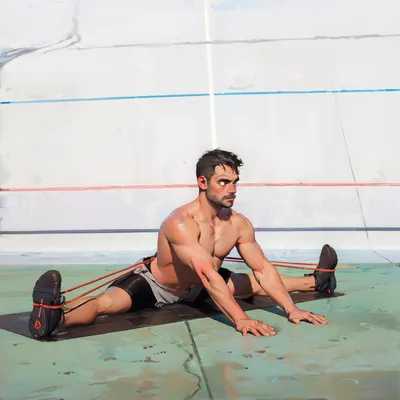
Your progress here is non-negotiable. You cannot fake Active Flexibility. These two qualities go hand-in-hand. You need to build leg-opening strength at your absolute end Range of Motion. Train your hip abductors and glutes with drills that mimic the handstand position. Lying on your back and performing banded leg openings is a great start. Progress to standing chest-to-wall drills, focusing on keeping the hips square and driving the External Rotation. There are no shortcuts here; you must do the work.
5.2. Mastering Your Splits: Hamstrings & Middle Split
Flexible Hamstrings are a prerequisite for a healthy Middle Split. If your hamstrings are tight, you can't fully straighten your legs, which forces compensation elsewhere. When stretching your hamstrings, you must maintain an Anterior Pelvic Tilt—a slight arch in the lower back—to properly target the muscle. For the Middle Split itself, stick to the classics. There's no need to get creative. Consistent work on foundational stretches like the frog pose and straddle holds on your back is what builds real, lasting flexibility.
5.3. Solidify Your Foundation: A Stronger Handstand
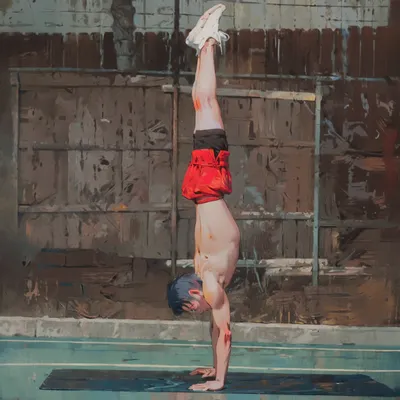
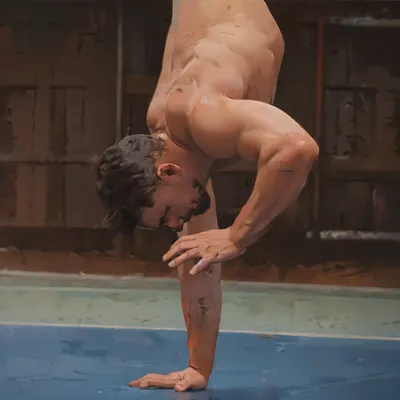
This is the piece most athletes forget. To actively open and rotate your legs, you must push against a stable base. That base is your shoulders. If your shoulders are weak and unstable, they will give way when you try to engage your legs, and the desired movement simply won't happen. Your ability to apply force to your lower body is directly limited by the stability of your upper body. Work relentlessly on your foundational Handstand Strength and Scapular Elevation. As your Handstand becomes more solid, it will be exponentially easier to focus on and control your legs.
6. Forge Your Unshakeable Foundation
A perfect Straddle Handstand is far more than just a beautiful shape. It is the gateway to stability, control, and a future of advanced Calisthenics skills. For the beginner, mastering this position is a monumental step in Body Awareness. For the advanced hand balancer, it is the bedrock upon which skills like the Stalder Press, One Arm Handstand, and countless transitions are built. You now have the blueprint. You understand the difference between a real straddle and a weak imitation. You know the dangers of poor form and the path to fixing it. The work is clear.
Get to work.