Unlock Your Straddle: The Power of External Rotation
Your straddle handstand feels heavy and looks crooked. The fix isn't more flexibility—it's this.
TABLE OF CONTENTS
1. The Anatomy of a Perfect Straddle Handstand
1.1. From Clumsy Pike to Clean Line
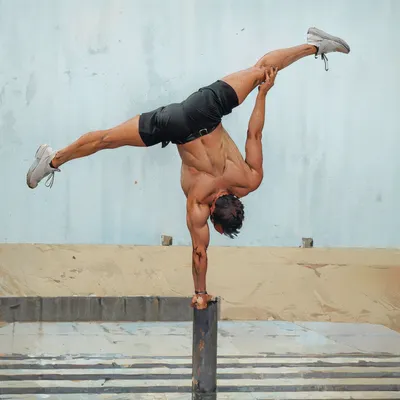
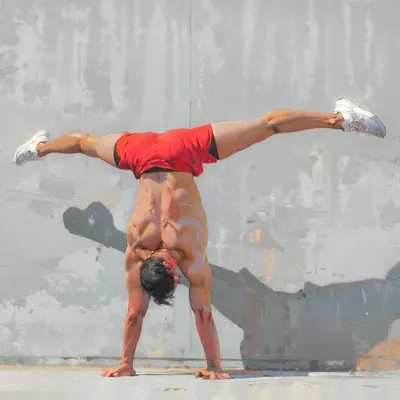
The straddle Handstand is a cornerstone shape in any serious calisthenics practice. It's not just an aesthetic choice; it’s a functional necessity. For the gymnast, it's a gateway to complex transitions. For the dancer, it’s an expression of control and elegance. For the One Arm Handstand aspirant, its wide Base of Support is the key to mastering Balance. But a straddle is not merely spreading the legs. The difference between a heavy, piked position and a light, perfectly aligned masterpiece is one critical component: External Rotation. Without it, you’re just fighting gravity. With it, you command it.
1.2. The Illusion of Flexibility
Many athletes see a beautiful straddle and immediately dismiss it, thinking, "I don't have a Middle Split, so this isn't for me." This is a critical error in thinking. While Passive Flexibility defines your absolute maximum range, the straddle Handstand is a demonstration of Active Flexibility. We are not concerned with the maximum turnout you possess, but with how much of your available turnout you can actively engage and control. The goal isn't to force a range you don't have, but to master the range you do. This is a game of Strength and Coordination, not just passive range.
2. The Unseen Engine: Why External Rotation is Non-Negotiable
2.1. The Physics of Efficiency
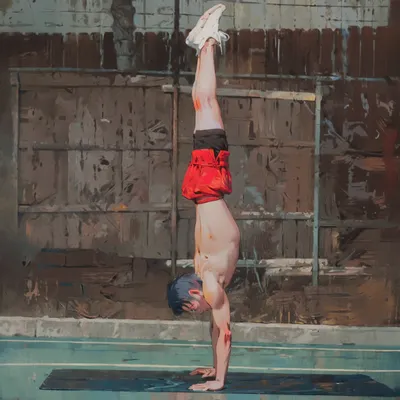
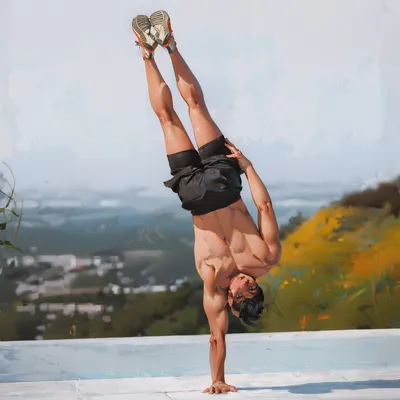
In a standard Handstand, your joints are stacked—hands, shoulders, hips, and feet form a straight, efficient line. Force transfers cleanly into the floor. The moment you open your legs into a straddle without External Rotation, this Alignment shatters. Your legs hang forward, your hips drop back to counterbalance, and your lower back arches to compensate for the displaced Center of Mass. You've created multiple Energy Leaks. The position becomes heavy, inefficient, and exhausting. Now, externally rotate. Squeeze the glutes. The feet travel back, the hips move into alignment, the back straightens. Your body becomes a single, rigid structure again. This isn't about looking better; it's about being more efficient. A well-aligned Handstand is an easy Handstand.
2.2. Forging an Unbreakable Structure
Picture your end Range of Motion as a solid wall. When you actively push your legs open using External Rotation, you are pressing them firmly against this wall. This creates immense Stability. The moment you relax that pressure, even slightly, your legs lose contact with that imaginary wall. Space is created, and in that space, instability thrives. Your legs will wobble and shake. This is a problem on two arms, but it is a complete deal-breaker on one. During a weight transfer to a One Arm Handstand, relaxed legs will inevitably close, throwing off your balance and destroying any hope of consistency. You must actively drive your legs against their end range, turning your hips and legs into one solid, unshakeable unit. There are no exceptions.
2.3. The Aesthetics of a Straight Line
While visual appeal is subjective, the pursuit of clean, straight lines is a universal standard in every high-level physical discipline, from gymnastics to dance to Calisthenics. A straight line communicates Control, precision, and mastery. External Rotation is the tool that carves this aesthetic out of your raw physical potential. It transforms a bent, broken line into a powerful, visually striking shape. It will take time, and your results will be dictated by your current level of Flexibility, but the visual payback from even small improvements is immense when you're upside down.
3. Engineering Your Turnout: The Blueprint
3.1. The Foundation: Passive Range of Motion
Your Active Flexibility can never exceed your Passive Flexibility. This is a non-negotiable rule. If you cannot open your legs into a straddle on the floor, you cannot expect to do it in a Handstand. The work starts on the ground. Improving your Middle Split, Hamstrings, and even ankle Flexibility is the first priority. This is the raw material from which you will build your turnout. Without a solid foundation of passive Range of Motion, you have nothing to activate.
3.2. The Activator: Specific Strength & Coordination
Flexibility is useless without the Strength to control it. This is where Active Flexibility training comes in. It refers to the specific strength in your glutes, lower back, and hip rotators required to open your joints against gravity. This is not something that happens by accident; it must be trained with specific, targeted drills. Building this Mind-Muscle Connection—the ability to consciously fire these small, deep muscles—takes time and focused effort. It's the engine that will drive your legs into position and hold them there with unshakable tension.
3.3. The Genetic Fallacy: Hard Work vs. Hardwired
Yes, genetics play a role. Bone structure and innate muscle insertions can give some athletes a head start. But hard work always beats talent when talent doesn't work hard. I have witnessed athletes with supposedly "bad" genetics achieve flawless middle splits through sheer Discipline and intelligent programming. Do not use genetics as an excuse. Use it as a reason to work smarter and harder. Your potential for improvement is always greater than you think. Find your limitations and then systematically destroy them.
4. The Training Protocol: Drills and Discipline
4.1. What You Must Do: The Essentials
To build a superior turnout, your training must be structured and consistent. Here is the protocol:
- Flexibility Training: This is your foundation. Warm up thoroughly until you break a light sweat. Focus on passive stretches like the Middle Split and Pancake Stretch, holding each for at least 45 seconds. Aim for 3-5 sessions per week.
- Active Flexibility Training: This builds usable strength. Perform these drills at the end of your flexibility sessions, 2 times per week. Drills like glute-activated leg lifts and seated straddle rotations are non-negotiable. Form is everything; never sacrifice Alignment for more range.
- Coordination Drills: These integrate Strength and Flexibility. Incorporate slow, focused movements that mimic the turnout action, like controlled leg rotations on your back. This builds the Mind-Muscle Connection essential for applying your strength upside down.
4.2. What You Must Avoid: The Saboteurs
Progress is not just about what you do, but also what you don't do. Avoid these common mistakes that will sabotage your progress and lead to injury:
- Training Cold: Low temperatures are the enemy of Flexibility. It makes tissues brittle and dramatically increases injury risk. Find a warm space, wear layers, or substitute the workout. No exceptions.
- Training Through Pain: Soreness from Active Flexibility work is real. Do not try to push through it with more active work. If you are sore, focus on recovery, use a foam roller, and listen to your body. Hip joints are not as forgiving as your pecs.
- Searching for Shortcuts: There are none. You must put in the consistent, focused work. Taking extended time off is not pausing progress; it's moving backward. Consistency is mandatory.
- Overtraining: Your body needs time to recover and adapt. Active flexibility training is demanding. Ensure at least 48 hours of Recovery between sessions and take at least one full rest day per week.
4.3. The Inflexible Athlete's Strategy
If you're working with limited mobility, your strategy must be precise. You can only rotate as much as your current Flexibility allows. Your goal is not to match a hyper-flexible athlete, but to maximize your own potential.
- For Alignment: You must find the exact point where your legs open so far that your hips begin to pike and your back arches. Your working straddle position is just inside this point. It may be narrower, but it will be perfectly aligned and efficient.
- For Stability: The most stable athlete is not the one with the most External Rotation, but the one who uses the highest percentage of their available rotation. No matter how limited your range is, you can hit your personal end range and actively push against it. This creates the lock, the stability you need.
5. From Knowledge to Mastery: Your Mission
The path to a masterful straddle Handstand is not paved with passive stretching alone. It is forged through the intelligent application of strength to your available range of motion. The two critical takeaways are this: First, a clean line is born from active External Rotation and glute activation, not just flexibility. Second, stability is not found in maximum range, but in actively pushing against your personal end range, no matter how limited.
The road is long and requires Discipline. But the reward—a stable, efficient, and visually stunning Handstand—is worth the investment. The sooner you start, the more consistent you are, the greater your success will be.
Get to work.