Handstand Walk: The Ultimate Guide to Strength & Control
Stop just holding. Start walking. Unlock a new level of functional strength and technical control with the handstand walk.
TABLE OF CONTENTS
1. More Than a Party Trick: The Raw Strength Gains
1.1. Forging an Iron Upper Body
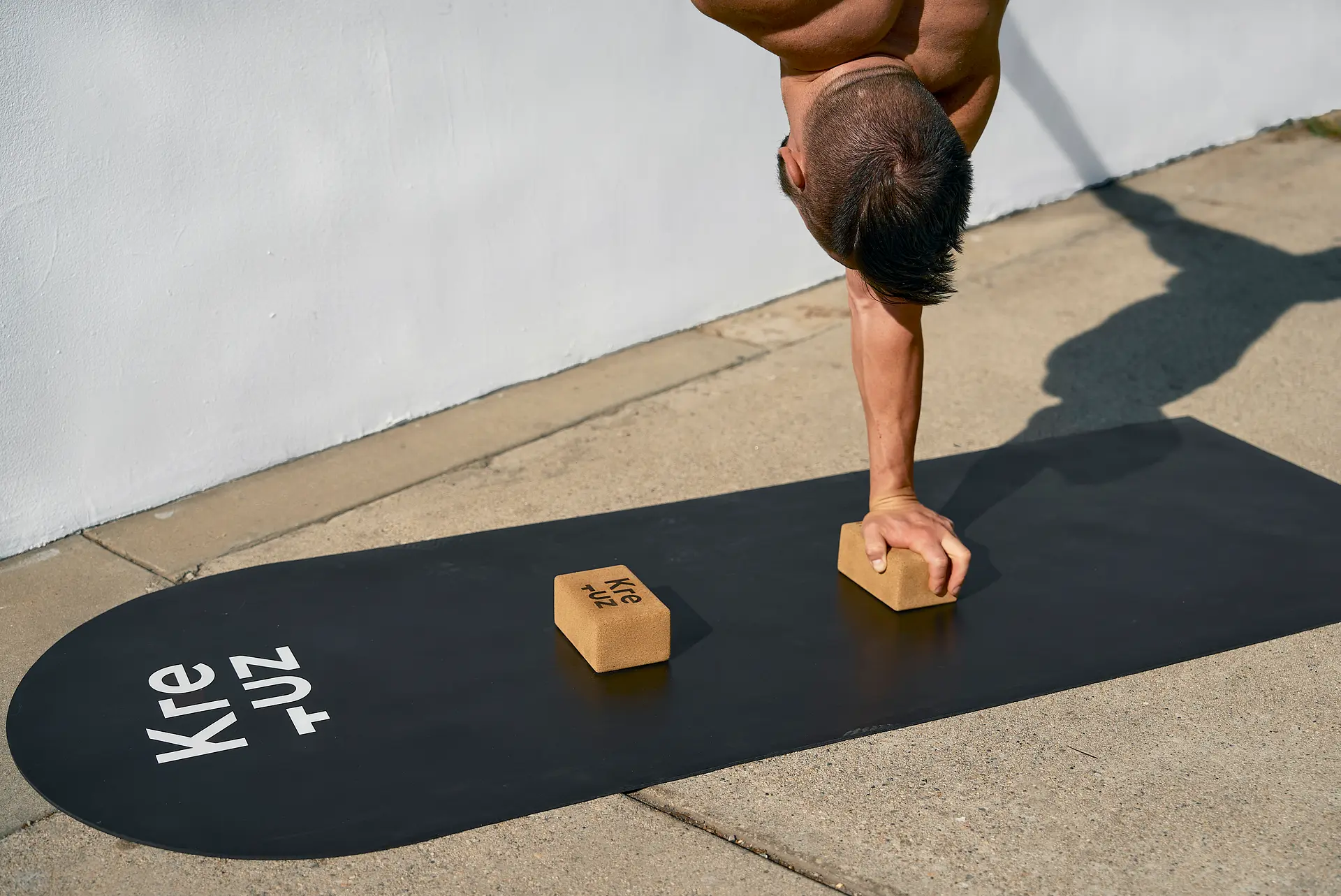
Let's cut to the chase. The Handstand Walk is not merely a show-off skill to glide across the gym floor. It's a crucible for building serious, functional strength. You might believe you’re not strong enough or that you don't know where to start. These are valid thoughts, but they are just thoughts. The reality is, the journey of training the Handstand Walk is more accessible than mastering a perfect static Handstand, and the strength it forges is immense. Forget what you believe you can't do. Every step you take on your hands is a rep—a rep that demands more from your body than you realize. Your arms, shoulders, and hands are forced to support and propel your entire bodyweight. This isn't just about pushing; it's about dynamic stabilization. Your triceps, forearms, and the muscles responsible for Scapular Elevation get a brutal workout. Your anterior deltoids work overtime, and even your biceps engage to control each placement. With every step, you're not just moving forward; you're executing a miniature, single-arm push-up. This unilateral load forces your shoulders to develop profound stabilizing strength and Anti-Rotation control, a quality that transfers to almost every other Calisthenics skill.
1.2. Building a Core of Steel
Your core—the entire cylinder of muscle connecting your hips to your shoulders—has one primary job during the Handstand Walk: stay tight. That sounds simple. It is not. While inverted and constantly shifting your Center of Mass from one hand to the other, maintaining a rigid, straight line requires immense Core Stability. Your abs and back muscles aren't just flexing; they are working isometrically to prevent your Kinetic Chain from collapsing into a 'banana' shape. This is where patience and practice pay off. The ability to maintain this tension while in motion is a high-level skill. The Proprioception and strength you build here are foundational, creating a stable platform that will make every other athletic endeavor you pursue more powerful and efficient.
1.3. The Unexpected Leg Workout
Yes, even your legs get a workout. You’re not performing Squats or Lunges, but the continuous effort of holding your legs overhead, keeping them engaged and stable, is a unique form of Time Under Tension. For many athletes, especially in the beginning, it's the legs that fatigue first during handstand training. This active engagement is crucial. If your legs are passive, they become dead weight, throwing off your Balance and creating Energy Leaks. Training the Handstand Walk teaches you to integrate your entire body into a single, cohesive unit, from fingertips to toes.
2. Sharpening Your Skill: The Technical Payoffs
2.1. Improving Handstand Holds and Control
It’s a paradox: walking on your hands makes you better at standing still. While the Handstand Walk might be dynamically easier than a 30-second static hold, the sheer volume of time spent upside down accelerates your learning curve. Each step is a micro-correction, a lesson in Balance and Fingertip Control. This constant, dynamic feedback sharpens your Upside Down Awareness at a rate that static holds alone cannot match. If you've hit a plateau in your Freestanding Handstand, introducing walking progressions can be the key to shattering it. It keeps your training fresh, challenging your body and nervous system in a new way, which often leads to breakthroughs in your static work.
2.2. Disconnecting Your Breathing
Can you breathe while walking on your hands? Most beginners can't. They hold their breath, rush through the walk, and collapse. But what if you could learn to disconnect your breath from your core tension? This is an elite-level skill, and handstand walking forces you to learn it. The conditioning work required will be so demanding that you simply won't have a choice but to breathe. You will learn to maintain a braced, stable core while your diaphragm moves independently. Master this, and you'll be able to hold a conversation upside down without sounding winded. This is the mark of true Control.
2.3. Normalizing the Inverted World
Your nervous system adapts to what you do most. The more time you spend upside down, the more 'normal' it becomes. The initial disorientation and sensory overload begin to fade. This is Neural Adaptation in its purest form. Malcolm Gladwell spoke of 10,000 hours for mastery. While you may not need that long, the principle of deliberate practice holds true. Consistent exposure through Handstand Walk drills desensitizes your brain to being inverted, allowing you to stay calmer, think clearer, and make better decisions when you're on your hands. This is how you transition from surviving upside down to commanding the position.
3. Forging a Resilient Mind: The Psychological Edge
3.1. Conquering Fear Through Competence
A huge part of learning to walk on your hands is practicing how to fall. Drills like the Cartwheel Bail Out aren't just safety measures; they are tools for building Confidence. This is the process of learning Controlled Falling. Every time you safely exit a failed attempt, you are teaching your brain that there is nothing to fear. Kicking up into a Handstand in the open is scary. Transferring your weight completely onto one hand is scary. But with each repetition, that fear gets a little smaller. Soon, you will look back and smile at the drills you were once worried about. This feeling of earned [c]Confidence[/e] is addicting and it will bleed into all other aspects of your training.
3.2. The Power of a Finish Line
The Handstand Walk is a precise, achievable skill. It has a clear finish line: you can either do it or you can't. This makes it a powerful goal. It is a challenge that, with a smart plan and consistent effort, is attainable for anyone, regardless of your starting point. When you set a physical goal and conquer it, you prove something fundamental to yourself. You prove that you can overcome obstacles through dedication. Once you internalize that lesson, you understand that you can apply that same focus and Resilience to conquer any goal you set, inside or outside the gym.
4. The Path Forward: Embrace the Journey
Yes, the Handstand Walk is a head-turner. It looks cool, and it feels incredible to perform. But the real value isn't in the destination; it’s in the process. The journey of training for this skill will forge you into a stronger, more skilled, and more resilient athlete. You will develop a deeper understanding of your body and a new level of [c]Confidence[/in your abilities. The process itself—the daily grind, the small wins, the conquered fears—is where the transformation happens. Setting the goal is the spark, but the journey is the fire.
Get to work.