How to Conquer Your Fear of Handstands: A Practical Guide
Scared of falling out of a handstand? Good. Here's how to turn that fear into your greatest weapon.

TABLE OF CONTENTS
1. Reframe Your Fear into Respect
1.1. The Truth About Being Scared
That feeling in your stomach when you kick up into a Handstand? The slight panic when your balance shifts? Good. That isn't true fear—it’s respect. It’s your body’s intelligent, primal appreciation for its own limitations and for the complexity of the skill you're demanding of it. We have to separate the idea of debilitating fear from earned respect. You’re not genuinely scared of a new movement; you simply respect its difficulty. Many years ago, my coach told me something that didn't click until much later: "You are not scared. You simply have respect for the height. Trust in your instincts and in the security that you know you have." She was absolutely right. The moment you reframe this feeling from a negative barrier (fear) to a positive signal (respect), you change the entire game. Respect is something you can work with. It's a signal to prepare, to build, to progress intelligently. Fear paralyzes; respect strategizes. This mindset shift is the first, most critical step. It’s the foundation upon which all physical progress is built, not just in the Handstand, but in every challenging endeavor you'll ever face.
1.2. Your Body Is Smarter Than You Think
If your mind is screaming at you not to go upside down because you’re scared your arms might collapse, it’s probably right. You can’t expect your arms to support your entire body weight if you've never systematically trained them for that specific load. This isn't a failure; it's your body's self-preservation mechanism firing perfectly. It's sending a clear signal to your brain: “Warning: current capacity does not meet the demand.” Listen to it. Respect it. And then, create a plan to prove it wrong. Your body already knows if it's ready. The so-called 'fear' is just the internal communication of that reality. It’s a call for better preparation and a more strategic approach to building Strength and confidence from the ground up.
2. Build an Unshakable Foundation
2.1. Train the Right Progressions
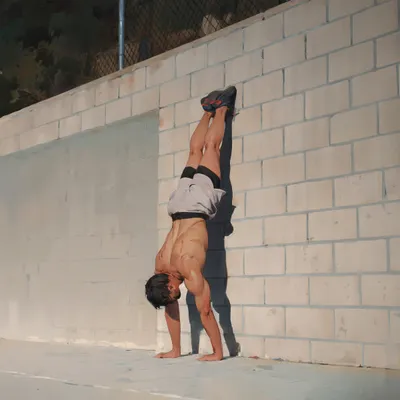
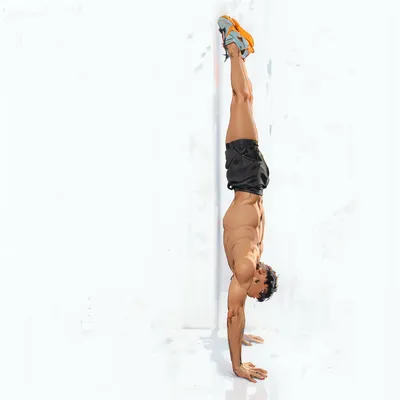
One of the biggest reasons you feel that sharp sting of fear is because you’re attempting a skill that you simply have no business doing yet. A classic example is the Chest to Wall Handstand. It’s a phenomenal drill and a non-negotiable milestone, but it demands a baseline of Strength and Body Awareness that must be earned first. Being scared to walk your hands close to the wall is a completely logical response if your shoulders and core aren't prepared for the load. The beauty of Calisthenics is the infinite scalability. There is always an appropriate progression. Instead of forcing the full drill, master the prerequisites. Spend time with an L Handstand on a box, a Wall Crow, or a Single Leg Wall Crow. Find the exact variation where you feel challenged, but the fear is a manageable whisper, not a deafening roar. Stay there. Own that position for a week or two. That is the essence of Progressive Overload. You slowly build capacity, and with capacity comes confidence.
2.2. Develop Overwhelming Strength
Confidence isn’t a mental trick; it’s a direct byproduct of capacity. You will stop fearing that your arms will collapse when you know, with absolute certainty, that they are strong enough to hold you twice as long as you need. So instead of tackling the Handstand directly, let’s build overwhelming Strength. Start with a simple Push Up Hold, then an Elevated Push Up Hold. Progress to Knee Push Ups, then full Push Ups. Once those are solid, you can start elevating the feet and working towards more demanding positions like the Pike Push Up and the L Handstand. Give your body the time it needs to build robust muscle and resilient connective tissue. This process cannot be rushed. As your physical Strength[/e] grows, your mental [c]Resilience will follow. The fear evaporates when it's confronted with undeniable physical proof of your capabilities.
3. Master the Art of the Fall
3.1. Analyze and Defuse the Threat
The primary fear in a Handstand is not being upside down; it's the uncontrolled return to earth. It’s losing balance, the split-second of confusion, and the potential impact. So, let’s confront this head-on. Analyze it. What you truly fear is the unknown in a rapid, potentially painful situation. The antidote to the unknown is preparation. Instead of hoping you never fall, you must prepare for the crash. We will turn you into an athlete who knows how to bail so instinctively that falling becomes just another transition. By learning to fall, you remove the consequence. When the consequence is removed, the fear has no power.
3.2. Learn to Bail Like a Ninja
It's time to learn how to crash safely. This means building your Proprioception and Coordination for tumbling. You need to teach your body how to react instinctively when things go sideways. The most direct path is to learn the Cartwheel. Start small, close to the floor. This isn't about perfect gymnastics form; this is about playtime. Get a mattress or train on grass and work on front rolls and ninja rolls. Feel your body moving through space in unfamiliar ways. The more comfortable you become with tumbling and rolling, the more trust you build. You are programming your nervous system with a 'safety-first' reaction. When you inevitably lose balance in a Handstand, your body won't freeze; it will execute the Cartwheel or roll you’ve practiced. This is how you transform a potentially dangerous fall into a controlled, fluid exit. This is how you conquer the fear of falling for good.
4. Forge Your Unbreakable Mindset
4.1. Respect the Process, Embrace the Grind
This is the big one. Give your body and mind time to adjust. And I don’t mean 20 minutes. I mean 20 days. 3 weeks. Consistently face your fear with these strategies, 3 times a week, for 21 days straight. On that final day, you will look back at day 1 and laugh. Three weeks is nothing in the grand scheme of developing elite Strength or Flexibility, but it's more than enough time to rewire your brain and adapt to new physical impulses. We see professionals make skills look easy and we fall into the trap of believing it should be easy. That is the definition of mastery—making the incredibly difficult look effortless. You are not there yet. You are a beginner. Do not kid yourself into believing you can shortcut years of dedication in a few attempts. Allow yourself the time to get there. Learn to celebrate the small victories—the first clean hold, the first controlled bail—with the same intensity as the final goal. Discipline and patience are your greatest allies.
4.2. From Fear to Freedom
As you can see, it is perfectly acceptable to feel fear. It is a sign that you are pushing your boundaries. But now you know the truth: it is not fear, but respect. To conquer it, you must take a step back and dismantle the threat piece by piece. You build a foundation with intelligent Progressive Overload, choosing progressions that challenge but do not terrify you. You forge more Strength than you think you need, creating a fortress of physical and mental confidence. And most importantly, you master the art of bailing, turning a fall from a disaster into a skill. You stop hoping you won’t fall and start knowing you can handle it if you do. This is the path from fear to freedom. This is how you unlock your potential not just in handbalancing, but in every aspect of your life. Now, you have the map.
Get to work.