Stalder vs L-Sit Press: Which Handstand Press to Learn First?
Stalder or L-Sit Press? The answer isn't what you think. Master your press with this definitive strategy.

TABLE OF CONTENTS
1. Defining the Arena: The Core Similarities
1.1. The Shared Foundation of Strength and Flexibility
Both the Stalder Press to Handstand and the L-Sit Press to Handstand are monuments of Straight Arm Strength and advanced Hand Balance. At first glance, they appear almost identical—a gravity-defying ascent from a seated or straddled position to a perfect Handstand. They are not for the uninitiated. Both demand an elite level of shoulder strength, pristine Coordination, and a profound degree of Compression and Hamstrings Flexibility. The path to either is paved with dedication. The fundamental question that confronts every serious athlete is not if they should pursue them, but which one to conquer first. This isn't a simple choice; it's a strategic decision that can either accelerate your progress or lead you down a path of frustration. To make the right call, we must dissect the subtle, yet crucial, differences in their mechanics and demands.
2. The Strength Debate: A Battle of Mechanical Advantage
2.1. The Stalder's Flexibility Advantage
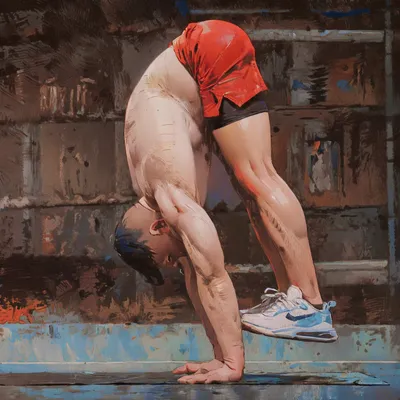
If your Flexibility far outstrips your raw strength, the Stalder Press to Handstand presents a compelling starting point. During the initial phase, the legs are open in a straddle or pancake position. This allows for a much deeper forward fold compared to the L-Sit, bringing your Center of Mass closer to your hands with less effort. Crucially, as you ascend, you don't have to lift through the notoriously difficult L-handstand position with legs parallel to the floor. Instead, you utilize your middle split flexibility to circle the legs around the body. You're effectively shaving corners, exploiting a Mechanical Advantage that makes the movement physically easier. However, this advantage comes with a major prerequisite: you must possess a beyond-flat Pancake and a proficient Middle Split. Without this hypermobility, the supposed advantage vanishes, and the Stalder Press becomes exponentially harder.
2.2. The L-Sit's Honest Strength Demand
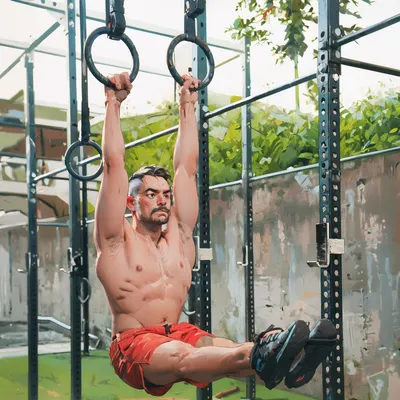
The L-Sit Press to Handstand is a more direct, uncompromising lift. It feels less like a fluid roll and more like a bodyweight deadlift. You cannot cut corners. You cannot use wide straddle mechanics to ease the burden. You must have the raw Overhead Pushing Strength and Compression to lift the entire weight of your legs through the horizontal plane of the L-Sit into the Handstand. However, let's be clear: any athlete seriously contemplating either of these skills is already exceptionally strong. The marginal extra strength required to lift the legs together in an L-Sit Press versus straddling them in a Stalder Press is often negligible in the grand scheme of your overall power. Therefore, when viewing it through the lens of pure strength alone, the two presses are more evenly matched than they first appear.
2.3. The Stalder's 'Cheat Code' Potential
We do not advocate for sloppy form, but it's important to understand every facet of a movement. The Stalder Press offers a developmental 'cheat' that the L-Sit Press does not. In the early stages, it's possible to climb with your legs onto your elbows, squeezing them hard before initiating the press. This creates a temporary shelf, making it significantly easier to elevate the hips. While this method won't build the specific Movement Pattern for a true, clean press, it can serve as a stepping stone to understand the feeling of getting the hips stacked over the hands. This is a tool, not a crutch. Use it wisely to learn, then discard it to build true strength.
3. The Decisive Factor: Technique and Efficiency
3.1. Why the L-Sit Demands Less Precision
This is the core of the argument. This is what truly separates the two skills and dictates the most logical learning order. The L-Sit Press to Handstand requires less technical precision and less intricate Coordination than the Stalder Press. Building strength and flexibility is a relatively straightforward process: you apply Progressive Overload, you recover, you adapt. You get better. Acquiring the refined Technique for advanced presses, however, is a different beast. It requires a surplus of strength and flexibility just to be able to hold the necessary positions long enough to explore the subtle muscle engagements and balance shifts. You need the capacity to make micro-adjustments and refine your Neural Adaptation to the movement.
3.2. The Stalder's Technical Complexity
The Stalder Press to Handstand demands significantly more of this highly specific, nuanced work. The timing of the hip lift, the continuous Compression, the straddle, and the final rollout into the Handstand must be perfectly synchronized. Any error in this complex Kinetic Chain results in failure. The L-Sit Press to Handstand, by being more direct, simplifies this process. You learn the fundamental principles of the press—the Scapular Elevation, the forward lean, the hip lift—without the added complexity of the straddle-around motion. This makes it a more efficient stepping stone. The time and energy you invest in mastering the L-Sit Press directly transfers to the Stalder Press, without teaching you any superfluous habits.
4. The Verdict: Your Strategic Path to Mastery
4.1. Forging Your Press to Handstand Dominance
The verdict is clear. Unless you are an athlete with vastly superior flexibility to your strength, the most logical and efficient path is to master the L-Sit Press to Handstand first. It builds the raw strength and fundamental Technique in a more direct, less technically demanding package. It forges the foundation upon which the more complex Stalder Press to Handstand can be built. Think of it as mastering the Chest to Wall Press/e] before the [e]Straddle Press to Handstand—a natural, intelligent progression.
This is not to say the Stalder Press is not a worthy goal. It is a beautiful display of skill. But by tackling the L-Sit Press first, you are playing the long game. You are building a base of power and control that will make the subsequent journey to the Stalder Press—and even skills like the Planche—smoother and more successful. Remember that progress doesn't end when you master one. This journey is continuous. Once you conquer one, the other will be within your grasp.
Now you have the strategy. The path is laid out before you.
Get to work.