Unlock Your Press: The Secret to Lower Back Engagement
Your press isn't failing because of your shoulders. It's your back. Here's the hidden key to unlock it.
TABLE OF CONTENTS
1. The Hidden Engine of the Press
1.1. The Counterintuitive Truth
In the world of Calisthenics, we worship the shoulders. We chase Overhead Pushing Strength and obsess over Scapular Elevation. But what if I told you the single biggest leak in your Press to Handstand, your Tuck Handstand, and your L Handstand has nothing to do with your deltoids? It’s a concept far too little discussed, a hidden engine that, once engaged, changes everything: the lower back. If you fail to engage this powerhouse, you will fall. It’s as fundamental as trying to walk without using your hip flexors. This isn't just about being upside down; it's about mastering the forces that are constantly trying to break your structure. For someone just starting with handstands this can feel strange, but mastering this is the key to unlocking a new level of Control and efficiency.
1.2. The Problem: A Game of Leverage
The challenge is simple physics. In a Tuck Handstand, L Handstand, or any Press to Handstand variation, your legs are on one side of your body’s vertical line. This creates a massive weight imbalance, with the majority of the load pulling you down on the side of your wrists where you have no fingers to push back. It's a losing game of leverage. The natural instinct is to fight this with raw shoulder Strength, but your shoulders alone cannot support the weight of your legs. They are just one link in the chain. Without a rigid connection, the Kinetic Chain is broken, your structure folds, and you collapse.
1.3. The Solution: The Anterior Pelvic Tilt
The solution is to forge that missing link by actively engaging the lower back. Now, just “tensing” your back is a useless cue. Try it now. Feel anything? Exactly. The action is specific: you must actively pull on the hips with the lower back muscles, creating what is known as an Anterior Pelvic Tilt. Think of it as trying to arch your lower back, initiating the movement from the pelvis itself. For most athletes, the back won't visibly arch, but the engagement is what matters. This muscular contraction locks your pelvis to your torso, connecting your legs directly to your shoulders. Suddenly, you can transfer pressure through your entire body into the floor. The moment this engagement relaxes, your legs become dead weight, and you will fall. This is non-negotiable.
2. Forging the Tools for Engagement
2.1. Building Usable Mobility
Understanding the concept is the first step, but owning it physically is another story. Before you can engage a muscle, you need the available Range of Motion for it to work within. The more flexible you are, the easier and more powerful this engagement becomes. A snail moves imperceptibly; a giraffe takes huge, obvious strides. Your lower back engagement is the giraffe. Invest time not just in the usual suspects—Pike Stretches and Pancake Stretches for your Hamstrings—but also in foundational back bending like the Cobra Pose. This isn't just about stretching; it's about creating the space for your strength to operate.
2.2. Mastering Coordination and Isolation
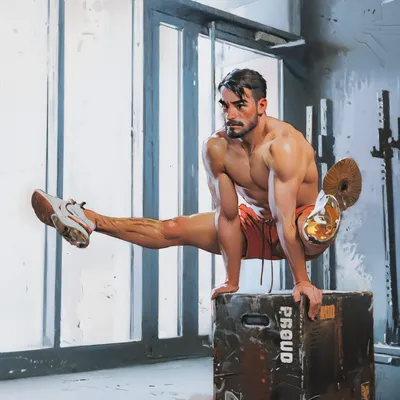
With the necessary range created, we must now learn to control it. This is a game of Coordination and developing a profound Mind-Muscle Connection. One of the most effective drills is an L Handstand with your quads resting on a table. From here, slide your legs away from you on the table to round the lower back. Then, pull them back with your lower back muscles, trying to arch past the starting point. This isolates the feeling of the Anterior Pelvic Tilt. To advance this, perform the drill with your back close to a wall. The goal is to touch the wall with your coccyx without your shoulders moving an inch. This teaches true isolation.
2.3. The Duality of Force
Here is where it becomes truly complex and beautiful. On top of pulling the hips into an Anterior Pelvic Tilt, we must also pull the legs down towards the body. In the Tuck Handstand, the knees must drive to the chest. In the Press to Handstand, the feet pull towards the wrists to create a Mechanical Advantage. Your hip flexors must fire with maximum intensity to create this Compression, while the lower back fires with equal intensity in the opposite direction to maintain the pelvic tilt. Mastering this antagonistic battle—this perfect storm of opposing forces—will give you a completely new understanding of how your body works. Your movements will become more efficient, more effortless, and infinitely more powerful.
3. Practical Application in Key Positions
3.1. The Tuck Handstand: A Perfect Laboratory
The Tuck Handstand perfectly encapsulates this entire concept. For beginners, it's a difficult balance challenge, but for understanding this specific engagement, it's the easiest environment. Your legs are bent, so hamstring Flexibility is not a limiting factor. You can pull your knees towards your chest with maximum force, using your ribs as a natural stopping point. Simultaneously, you can pull on your back as hard as possible without fear of over-arching. In the tuck, everything just works. It is the perfect laboratory to feel the intense, locked-in stability that comes from this dual engagement.
3.2. The Press to Handstand: The Hamstring Factor
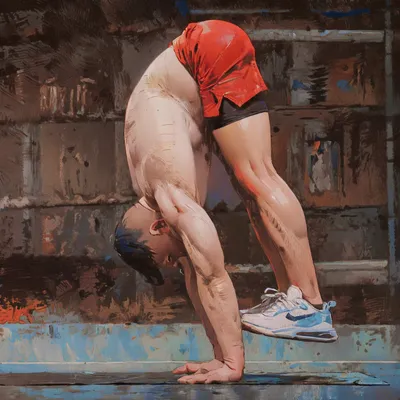
The same forces are at play in the Press to Handstand, but with a critical difference: your legs are straight. This immediately brings your hamstring Mobility into the equation. Your hamstring flexibility now actively works against your hip flexors, making the Compression part of the engagement significantly harder than in the tuck. Furthermore, this is a dynamic movement, not a static hold. The lower back engagement must begin before your feet even leave the floor and must be maintained until the final moment you transition from pulling in to extending up into the handstand line.
3.3. The L Handstand: A Game of Millimeters
Returning to a static hold, the L Handstand introduces a new challenge: modulation. Unlike the tuck or press where you can engage at 100%, the L Handstand demands precision. You only want to pull with enough force to hold your legs perfectly parallel to the floor—no more, no less. Engaging to, for example, 74.3% is infinitely harder than engaging at maximum capacity. Pull too hard with the hip flexors, and you'll pike. Engage the back too aggressively, and you risk over-arching into a contortion-style handstand. It's a delicate, razor's-edge balance that demands supreme Control.
3.4. The Stalder Press: The Test of Patience
The Stalder Press presents the same limitations as the standard press but adds a cruel twist: a delayed onset of engagement. You cannot pull your hips into an Anterior Pelvic Tilt from the start. You must first lift and round your back to bring your hips up and over your shoulders. Only when your shoulders are almost fully open can you finally fire the lower back to pull everything into Alignment. This delay tests the patience and trust of even seasoned athletes. It’s a testament to the idea that in advanced skills, timing is everything.
4. Integrate and Dominate
4.1. You Are Only as Strong as Your Weakest Link
This principle is not just a concept; it is a physical system that relies on Strength. If your lower back is not strong enough to counteract the weight of your legs and the pull of your hip flexors, your hips will roll into a Posterior Pelvic Tilt and you will fall. If your shoulders are not strong enough to remain open under the combined forces, they will collapse and you will fall. You must work on each strength component separately: the shoulders, the Anterior Pelvic Tilt engagement, and the hip flexor Compression. Once you have the requisite Mobility and Coordination, you must train them all together to gain full command of your body.
4.2. Beyond the Handstand
Mastering this interplay of forces does more than just unlock your handstand presses. It forges a stronger bond with your own body, dramatically increasing your Proprioception and Mind-Muscle Connection. This newfound awareness of how to create and resist forces from your center will carry over to every other skill you train, from the Planche to the Front Lever. You are not just learning a trick; you are learning the language of high-level movement. Invest the time. Build the Mobility, forge the Coordination, and develop the Strength. It will go a long way. Get to work.