The Handstand Code: Unlocking True Balance & Control
Stop fighting for balance in your handstand. The secret to a rock-solid line isn't what you've been told.

Start Training Handstand Today for Free
TABLE OF CONTENTS
1. The Myth of the "Perfect" Handstand
1.1. Why "Find Your Own Way" is Flawed Advice
Let's get one thing straight. If a coach tells you to just “find your own technique” for the Handstand, you should walk away. That isn't coaching; it's a lazy guess. In amateur sports, you see a mess of different techniques. But at the Olympic level? Everyone moves with near-identical precision. This isn't a coincidence. It's the result of years of applied Biomechanics and trial-and-error, revealing the single most efficient way to perform a movement. Hand Balance is no different. Professional hand balancers don't all have unique, quirky techniques. They converge on the same principles of physics because those principles work. When you first get upside down, total control feels impossible. It feels like a chaotic fight for survival. But with the right focus and a clear understanding of the mechanics, the Handstand transforms from a battle into a controlled, calculated skill.
1.2. The Goal: Universal Efficiency, Personal Adaptation
We are not all Olympic athletes who started training at age five. Most of us are adults with jobs, responsibilities, and bodies that have accumulated years of specific tightness and limitations. So, while we all strive for the same mechanical perfection, we must accept that our expression of it will be unique. Your personal limitations—tight shoulders, a stiff back—will require intelligent adaptations. The goal is not to invent a new way of doing a Handstand, but to apply the universal principles of efficiency as purely as your own body allows. To do that, you must first understand how a Handstand actually works.
2. The Pillars of an Unbreakable Handstand
2.1. The Straight Line: Your Path to Efficiency
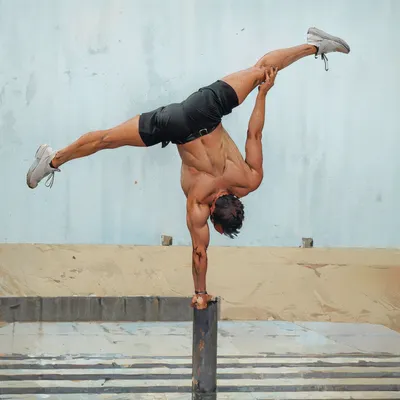
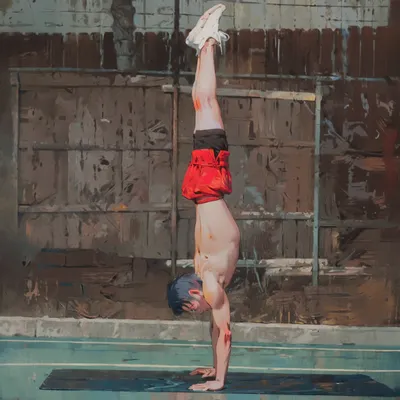
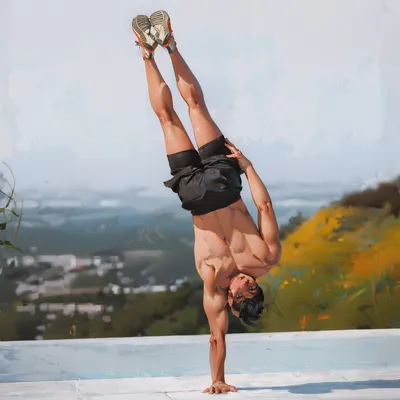
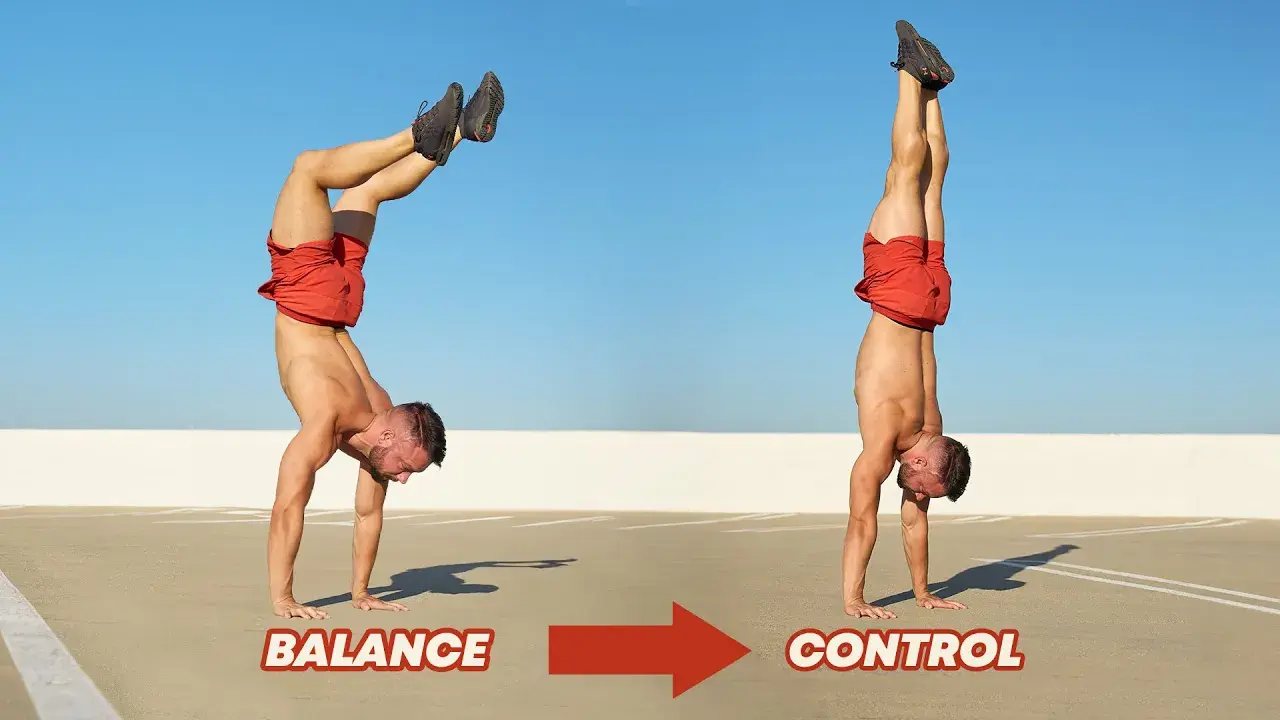
What makes a Handstand efficient? The same thing that makes standing upright efficient. Picture yourself waiting for a bus, casually standing. Now, compare that to holding a Wall Sit. Which one could you do for longer? The straight line, obviously. A Handstand is a battle against gravity. When you achieve a straight line, you are using your skeleton for support, stacking your joints directly on top of one another. This is Joint Stacking. When your elbows bend, your back arches, or your scapula collapses, your muscles are forced to work overtime to hold the broken line together. You become heavy. To make your Handstand feel light and effortless, you must push tall, actively engage in Scapular Elevation, and forge a perfectly straight, stacked line from your hands to your feet.
2.2. Fingertip Pressure: The Secret to Absolute Control
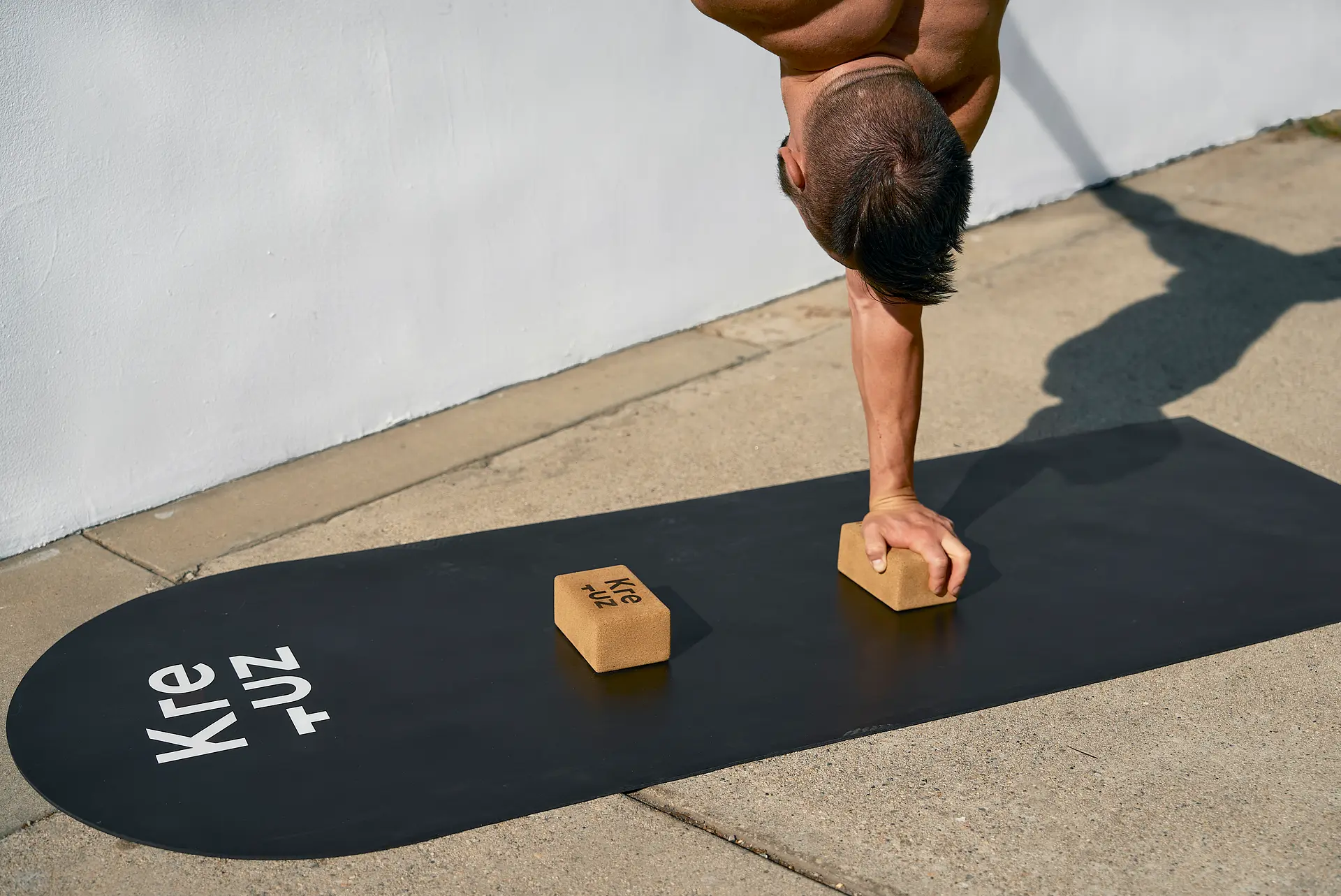
Here is a truth that many misunderstand: a controlled Handstand is not an easy handstand. While the straight line makes it easier on your shoulders and back, true control requires you to keep it hard on your fingers. Think about standing on your feet. When your weight is forward in your toes, you feel powerful, anchored, and in control. The moment your weight drifts back to your heels, your arms flail and you have to scramble to rebalance. It is precisely the same on your hands. Control does not come from being perfectly centered. Control comes from a slight forward lean, with constant pressure in your fingertips. This is Fingertip Control. As long as you are leaning into your fingers, you are in charge. You can manipulate your position by modulating the pressure. Fall forward? Press harder. Fall back? Ease off. You are no longer just balancing; you are piloting your body. This burns, especially as sets get longer, but this is where real control is forged.
3. Deconstructing the Handstand: How to Fix What's Broken
3.1. The Stillness Illusion: Embracing Micro-Corrections
A handstand that appears perfectly still is an illusion. In reality, it's a living, breathing organism, a constant dance of micro-corrections. You will always be falling in one direction. Your brain will detect this, and you will react to correct it. You will push back, sometimes too far, and begin falling the other way. This never stops. The difference between a beginner and a pro is not the absence of these corrections, but their speed and precision. A master's Proprioception is so finely tuned that the corrections become invisible to the naked eye, a subtle firing of forearm muscles. Stop chasing the ghost of perfect stillness. Instead, embrace the process of constant, intelligent correction.
3.2. Error 1: Shoulders Forward, Back Arched (The Classic Banana)
This is the most common handstand fault. Fatigue sets in, your shoulders can't maintain the open, elevated position, and they drift forward. To keep your Center of Mass over your hands, your body instinctively arches the back, creating the dreaded “banana” shape. While this keeps you from toppling over immediately, it's an inefficient, high-stress position. The Fix: The correction is direct, but requires strength. You must consciously push down hard into the floor to re-engage Scapular Elevation. As you push tall, focus on keeping your weight in the fingertips to maintain control while you straighten the line.
3.3. Error 2: Shoulders Forward, Hips Piked (The Over-Lean)
Here, your shoulders move forward but remain relatively open. You've leaned too far, the pressure on your fingertips becomes immense, and your hips automatically pike to pull some weight back and relieve the strain. This is a critical error. With your hips piked, your weight is now falling backward toward your wrists. You have lost your primary leverage point for control. The Fix: This is a difficult save. You must fight to get your weight back into the fingertips first. Only then can you simultaneously move your shoulders back and open your hips into a straight line. This position places your wrists at a sharp, vulnerable angle; proceed with caution.
3.4. Error 3: Shoulders Back, Back Arched (The Unintentional Hollow Back)
If your shoulders can drift forward, they can also drift backward, past your wrists. When this happens, your back will naturally arch, and you'll fall into a shape that resembles a Hollow Back Handstand. The problem with this—and advanced skills like the `Mexican Handstand`—is that your weight has shifted to the back of your hands. You've lost your Fingertip Control and are now forced to balance with your entire body. The Fix: This requires immense control. You must engage your back muscles to arch slightly more, which will paradoxically shift your hips and feet forward, bringing weight back to the fingertips. Once you feel that pressure, you can push tall and re-center your shoulders.
3.5. Error 4: Shoulders Back, Hips Piked (The Confused Stack)
This is the most chaotic misalignment. Your shoulders are back, but instead of arching, your hips pike. This creates multiple breaks in the Kinetic Chain and becomes incredibly confusing to fix. Your weight is distributed poorly, and you have no clear point of control. The Fix: The principle remains the same, no matter how chaotic the position. Your first and only priority is to regain Fingertip Control. Engage whatever muscles you can to shift your weight forward. Once you have that fingertip pressure, you can begin the delicate process of moving your shoulders forward while simultaneously opening the hips to realign the stack.
3.6. Error 5: The Straight Line with No Control (The Empty Stack)
This is the most deceptive error. You achieve a perfectly straight line, scapula elevated, but you feel floaty, fragile, and unable to make corrections. This happens when you've aligned your body over your wrists instead of the center of your hands. You have the shape, but not the control. You're not waiting for the bus with your weight on your heels. The Fix: You must intentionally break your perfect line to save it. Engage your back to create a tiny arch, allowing your shoulders to travel forward until you feel solid pressure in your fingertips. Once that control is established, push tall again, locking in the new, effective alignment.
4. Forging Your Path to Mastery
4.1. Film, Analyze, Dominate
The camera is your most honest coach. It has no ego, and it does not lie. Filming yourself regularly is not for social media; it is for ruthless analysis. Take screenshots of your holds. Put them side-by-side with the examples in this article. See where your line breaks down when you get tired. The more you analyze your own movement, the more you will internalize the feeling of correct alignment and the faster your learning curve will be. You have to see it to feel it, and feel it to fix it.
4.2. The Ultimate Takeaway
Understanding your Handstand is not complex. It boils down to two non-negotiable truths. One: A straight, elevated line from hands to feet is the most efficient structure. Two: A forward lean with constant pressure in the fingertips is the only source of true control. Stop chasing the illusion of stillness and start mastering the art of correction. Understand the system, diagnose your errors with precision, and execute the fixes with intent. Get to work.