5 Chest to Wall Handstand Mistakes Sabotaging Your Progress
Using the wall for handstands? You're likely making these 5 progress-killing mistakes. Here's how to fix them.

TABLE OF CONTENTS
1. The Deadly Gaze: Why Looking at the Wall Kills Progress
1.1. Tucking your chin is choking your strength
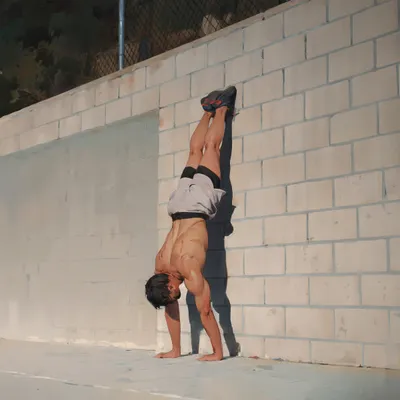
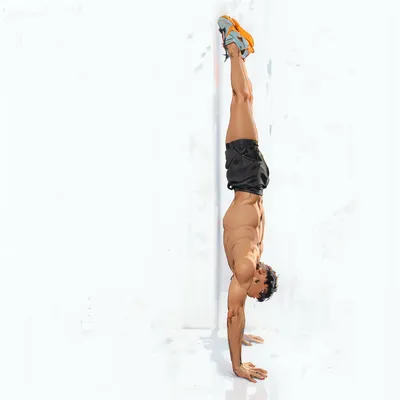
When you're starting out, the wall is your best friend. It takes balance out of the equation, allowing you to build the raw strength, Coordination, and sheer Body Awareness needed to one day stand free. But just like my old math teacher used to say, a calculator is only as smart as its user. The wall is only as effective as the athlete makes it. If you train with sloppy form, you're not just slowing your progress—you're cementing bad habits that will be a nightmare to unlearn. The first and most tempting mistake is looking at the wall. When the pressure mounts and fatigue sets in, your eyes will want to drift upwards. Resist. Here’s what happens when you don't: looking at the wall forces your chin to your chest. This move might feel like it's improving your line by opening your shoulders into Shoulder Flexion, but it's a trap. In this position, you physically cannot achieve full Scapular Elevation. This means you can't push tall, you can't protect your shoulders from injury, and you will never take full control of your handstand. Instead, pull your head back until you can see your hands, allow your shoulders to close just slightly, and push tall. Create that solid, stable shelf.
2. The Passive Lean: Treating the Wall Like a Couch
2.1. This is training, not nap time
Your feet should be the only part of your body touching the wall. Period. If you can feel your quads, hips, or belly resting against the surface, you are broadcasting a massive lack of engagement. This isn't a passive hold; it's an active battle against gravity. Leaning signals to your body that it can switch off, outsourcing stability to the wall instead of building it from within. This is where drills like the Plank and the Hollow Body Hold become non-negotiable. You need to "dry swim" these positions on the floor until they become second nature. Build such a strong Mind-Muscle Connection with your core that it fires on autopilot the second you're inverted. Engage your core to actively lift your hips and body away from the wall. This creates the tension necessary to build true Handstand Endurance and protects your lower back from sagging into a dangerous, unsupported arch. Don't just hold the position—command it.
3. The Energy Leak: Why Bent Elbows Are Weak Elbows
3.1. Lock out or lose out
Unless you have significant hyperextension, your elbows must be fully locked. Imagine waiting for a bus. You stand with your knees locked because it's efficient. Waiting in a half-squat would be pointlessly exhausting. The same principle applies to your handstand. Bent elbows are weak elbows. They are a massive energy leak, forcing your muscles to work overtime for zero benefit. A bent elbow makes it nearly impossible to achieve full Scapular Elevation. The sequence of failure is predictable: first, the scapula depresses, then the elbows bend. If your arms are already bent in your Chest to Wall Handstand, I can guarantee you are not pushing tall. You are surviving, not training. This habit will cripple your progress towards more advanced skills like the Handstand Push Up.
3.2. Finding the root of the bend
If you struggle with bent elbows, we need to diagnose the cause. First, can you fully straighten your elbows without any load? If not, this is a Flexibility issue. Gently stretch your biceps and shoulders, and keep your arms warm. Slow, consistent progress is the goal here. If you feel pain or instability, consult a sports physiotherapist. However, if your elbows straighten just fine when unloaded, the answer is simple: you lack Overhead Pushing Strength. All arm extension drills are your new best friend. Start working on Pike Push Up variations and tricep-specific isolation work like Overhead Triceps Extensions. Build the strength to support your structure.
4. The Banana Back Trap: Unlinking Shoulders and Spine
4.1. The nemesis of the straight line
The Banana Handstand is the great nemesis of every aspiring hand-balancer. It's an inefficient, unstable line that puts immense strain on your shoulders and wrists. While a weak core can contribute, the primary culprit is almost always closed shoulders. When your shoulders lack the necessary Shoulder Flexion to open fully, they create an angle. To compensate and keep your center of mass over your hands, your back is forced to arch. Simply “squeezing your core” will not fix this mechanical reality. The problem is a lack of Scapular Control and elevation, not just abdominal weakness.
4.2. Building strong and open shoulders
Unless you know for a fact you have hypermobile shoulders, you need a two-pronged attack: improve both Flexibility and strength. Incorporate traditional shoulder opening stretches into your routine, but dedicate the majority of your time—around 75%—to active drills. Focus on exercises that build specific strength and coordination[/-c] for [c]scapular elevation, like Scapular Shrugs and Wall Slides. You need to teach your nervous system how to activate these muscles upside down to create a stable platform for your handstand, independent of your back position.
5. From Apprentice to Architect: Mastering Your Foundation
5.1. Elevation over aesthetics
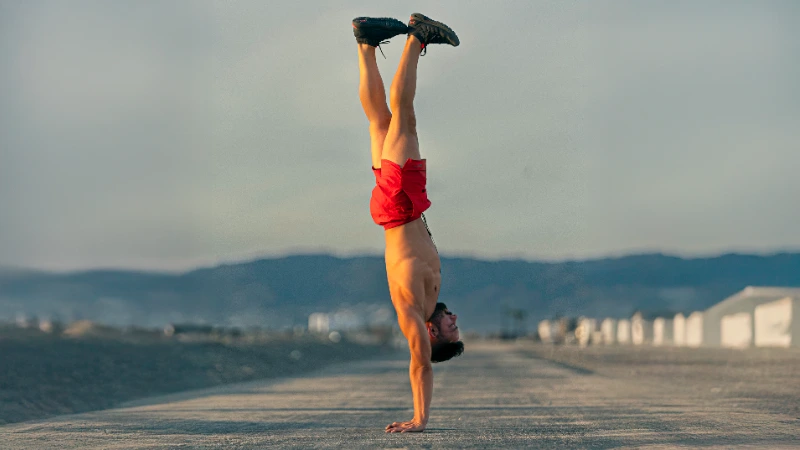
I know it’s tempting to chase that perfect, razor-straight line for the Instagram pictures. But focusing on your line while you're still mastering the Chest to Wall Handstand is a misinvestment of your energy. First, a perfectly vertical line is impossible against the wall; a slight lean is required. Second, and more importantly, the line isn't what truly matters in a high-level handstand. I've seen elite hand-balancers with imperfect lines who possess one non-negotiable quality: ultra-high Scapular Elevation. This is your goal. Forget the aesthetics for now. Focus on the feeling of pushing the ground away, covering your ears with your shoulders, and creating the strongest, most stable Joint Stacking possible. A powerful, elevated handstand is infinitely more impressive than a wobbly, pretty one.
5.2. Become your own coach
Most of the time, you won't have a coach watching your every move. You are in charge. It's impossible to improve if you don't understand your own mistakes. Study the common errors in this guide. Film yourself. Compare your form to the correct examples. Understand why these mistakes cripple your handstand and then diligently apply the cure. Knowledge is the ultimate tool. The more you understand about your body and the principles of training, the more efficient your workouts become, and the faster you will dominate your goals. Stop making excuses. Start building your foundation.
Get to work.