The #1 Handstand Mistake That's Killing Your Progress
Still training handstands with your back to the wall? You're practicing failure. Here's the truth.

TABLE OF CONTENTS
1. The Anatomy of a Flawed Handstand
1.1. Deconstructing the Banana Back
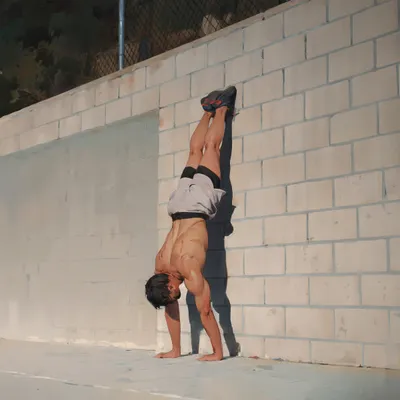
I get it. The Handstand is a formidable skill. Progress feels slow, and fear is a constant companion. In moments of frustration, the idea of an easy win—a simple, fear-free moment of being upside down—is incredibly tempting. Training with your back to the wall feels like that easy win, a safe harbor in a storm of difficult training. But this perceived safety is a lie. It's a form of fake progress that not only stalls your development but actively makes your Handstand worse. The back-to-wall handstand isn't a step forward; it's a step into a meticulously crafted trap. The most immediate and damaging consequence of training with your back to the wall is the catastrophic effect it has on your Alignment. A perfect Handstand is a study in efficiency, a vertical stacking of joints that allows your skeleton to bear the load, minimizing muscular effort. When you kick up with your back to the wall, this entire structure crumbles. To reach the wall with your heels, your body is forced into an arch. This isn't a minor flaw; it is the very definition of the dreaded Banana Handstand. Your shoulders close, your ribcage flares, and your lower back hyperextends. You are systematically grooving a dysfunctional movement pattern, creating Energy Leaks that will haunt every freestanding attempt you make.
1.2. The Superiority of Chest-to-Wall
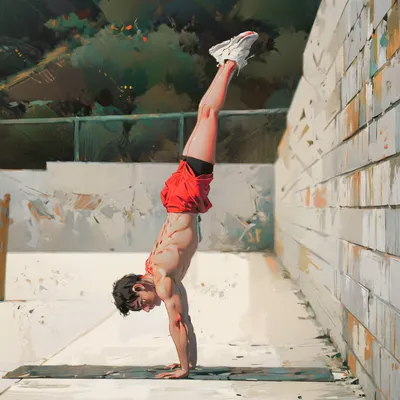
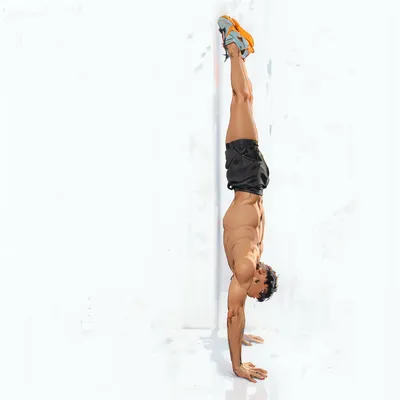
Now, contrast this with the chest-to-wall Handstand. By simply turning around, you change the entire dynamic. With your chest facing the wall, the wall itself becomes a guide for a straight line, not an obstacle to it. You can walk your hands closer to the wall, achieving a near-perfect vertical Alignment that is impossible with your back to it. In this position, you can focus on the correct cues: achieving full Shoulder Flexion, practicing powerful Scapular Elevation—pushing tall through the shoulders—and engaging your core to maintain a hollow body shape. The chest-to-wall position doesn't just prevent bad habits; it actively builds the specific strength, Coordination, and Upside Down Awareness required for a truly controlled Freestanding Handstand. It is the honest path, the one that builds real, transferable skill.
2. You Are Rehearsing Failure
2.1. Practicing the Overshoot
Every time you kick up with your back to the wall, you are not practicing a Handstand; you are practicing how to overshoot it. Think about the mechanics: to get your feet to the wall, your Center of Mass must travel past the point of balance. You are literally rehearsing the motion of falling over. You spend weeks, even months, drilling this over-kick, building a powerful motor program for failure. Then, the day comes when you feel confident enough to try it without the wall. You kick up with the same ingrained force and trajectory, fly past the balance point, and fall. The frustration is immense, but the outcome was predictable. You became an expert at the one thing you were trying to avoid. Instead of this, dedicate your time to drills that build Control and Body Awareness, like chest-to-wall slide-aways and Single Leg L Handstand Isolation drills. These teach you to find and manage the point of balance, not to blow past it.
2.2. The Missed Opportunity for Fingertip Control
Balancing a Handstand is an active process. It’s a constant conversation between your brain, your body, and gravity, with your hands acting as the primary communicators. The fine-tuning, the micro-adjustments that keep you upright, comes from your hands and fingers. This is Fingertip Control, the most crucial element of Hand Balance. When you train back-to-wall, you rob yourself of the opportunity to develop this skill. The wall becomes a crutch, a silent partner that does all the work. Your body never learns to feel the subtle shifts in weight or to respond by pressing through the fingers to correct them. You are building Strength without intelligence, a powerful engine with no steering wheel. The chest-to-wall position, by contrast, forces you to begin engaging your hands, as you actively push away from the wall to find your balance.
3. The Illusion of Safety
3.1. Why You Never Conquer Fear
It’s understandable to be scared of falling. A Handstand is an unnatural position, and the fear of crashing down is primal. The back-to-wall position feels like a safety net, a way to experience the inversion without the risk. Here's the hard truth: if you never fall, you will never understand that falling isn't that dangerous. The fear doesn't just disappear; it is conquered through experience. By constantly relying on the wall, you are nurturing your fear, letting it grow in the absence of evidence. The only way to overcome the fear of falling is to fall, and to do so in a controlled manner. This is where learning to bail becomes a non-negotiable part of your training. A simple Cartwheel Bail Out or a forward roll transforms a fall from a moment of panic into a controlled, predictable movement. Practice bailing. Get your mattress, put it on the floor, and just fall a few times. This process of Controlled Falling demystifies the experience, building true Confidence that no wall can ever provide.
3.2. Building False Confidence
The confidence you gain from back-to-wall handstands is brittle. It's built on a foundation of lies. You feel successful because you can hold yourself upside down, but this success is entirely dependent on the wall. It doesn't translate to the open floor. This creates a dangerous psychological trap. You believe you are more advanced than you are, leading to immense frustration when your freestanding attempts fail. True Confidence is earned. It's forged in the fire of thousands of reps, of fighting for balance, of successful bails, and of understanding your body's limits. It’s the quiet knowledge that you possess the skills to manage the position, not the loud proclamation that you can lean against a wall.
4. The Path to True Control
4.1. Fight for Every Second
So, what is the alternative? It is to embrace the struggle and to turn around. The path to a masterful Handstand is paved with chest-to-wall holds, slide-aways, and controlled bails. It's about building authentic Strength, impeccable Alignment, and unshakable Confidence from the ground up. You must learn to fight for every single handstand. That moment when you feel your balance wavering is the most important part of your training. This is where you learn to push with your fingers, to shift your weight, and to engage your core. Back-to-wall training teaches you to give up at the first sign of trouble; your foot instinctively reaches for the safety of the wall long before it's actually necessary. This habit is poison. To truly learn to balance, you must explore the edges of your control, fight to stay in the air, and understand just how much you can save a failing rep. This fight develops Proprioception and Resilience.
4.2. Embrace the Process
Stop chasing the illusion of easy success. The back-to-wall handstand is a shortcut to a dead end. It ingrains bad habits, fosters fear, and builds a fragile confidence that shatters in the open space. Turn around. Face the wall. Embrace the honest work of building a handstand on a foundation of correct principles. Build the specific muscles, the Coordination, and the Upside Down Awareness that will actually serve you. It will be harder. It will require more patience. But the progress you make will be real, it will be lasting, and it will be yours. The wall is not your enemy; it is your most honest coach. Use it correctly.
Get to work.